
Google Flights Guidelines: How To Find Cheap Flights
There are numerous search engines available for finding affordable flights, such as Kiwi, Skyscanner, Hopper, and popular online travel agencies like Priceline or Expedia. However, among all these options, Google Flights stands out as the superior choice, widely praised and talked about by everyone.

By Eglė
Published: July 14, 2023 • 8 min read
Updated: September 9, 2026

We've written a lot about how to find affordable hotels on Booking, how to use Google Hotels, and put together an ultimate flight booking guide. Google Flights is worth a guide of its own. What follows are the tips and tricks that get you the lowest fare, and the places where the tool falls short.
In This Article
- Why Google Flights
- What Google Flights Does Well
- Where Google Flights Falls Short
- How to Search
- Filters Worth Using
- Booking Direct
- Finding the Cheapest Days
- Is It Actually a Good Deal?
- The Explore Map
- The Bottom Line
Why Google Flights
Google's search engine differs from travel search engines like Expedia, Kayak, Orbitz, and Skyscanner. Those platforms are online travel agencies, where you buy flights, hotels, cruises and other arrangements directly. Google works more like a distribution platform, where airlines themselves publish their fares. You will also find some fares from major agencies such as Expedia or Priceline. In practice it is a one-stop shop for looking at what exists on a route.
What Google Flights Does Well
Because it is not an online travel agency, Google Flights has some real advantages over other flight search engines.
- Booking directly with the airline is almost always an option. You will sometimes be offered other websites, but going straight to the airline matters more than people expect. Dealing with an airline's own agent beats chasing customer service at a small agency, and it saves a lot of time when something goes wrong.
- The calendar-based fare view is the best in the business. No other flight search engine shows you a comparable spread of dates at a glance, which makes it easy to see which days are cheapest before you commit to any of them.
- You can search several airports at once. This is invaluable when you are trying to work out the cheapest departure or arrival airport for an international trip.
- The filters are unusually good. You can exclude stops, pick specific airlines and cabin classes, check the carbon footprint, and see how a fare compares with the typical price for that route.
- It is fast. Months of fares appear in a fraction of a second, which no other engine matches.
- The Explore map finds destinations, not just flights. It shows you the cheapest places you can fly from your airport on your dates, which is the single best reason to use it over anything else.

Where Google Flights Falls Short
Even with those strengths, there are real limitations.
- It does not always have the lowest fare. Google Flights mostly shows airfare published by airlines. Online travel agencies sometimes negotiate discounted fares with carriers that never appear on Google at all.
- Pricing can be out of date. Google refreshes inventory constantly, but you can still find a price on Google Flights and then meet a higher one when you click through to the airline.
- A few airlines still do not publish fares to search engines. The list has shrunk over the years, so check the airline's own site directly if you suspect it is missing from your results.
- Fares can vanish between search and checkout. Sometimes the price jumps when you go to book; sometimes there is no online booking option at all and you are told to phone the airline, which rarely works. This is known as "ghosting", and it happens when a fare was available very recently but no longer is.
How to Search
Start on the Google Flights website, on desktop or a phone browser. There is no Google Flights app. The interface is straightforward.
The menu in the top left corner, the three dashes, holds shortcuts to Search Flights, Explore, and Tracked Prices, which is where you monitor fares on routes you care about. You can also reach your upcoming trips and adjust settings like country, language and currency, which is worth doing before you search.
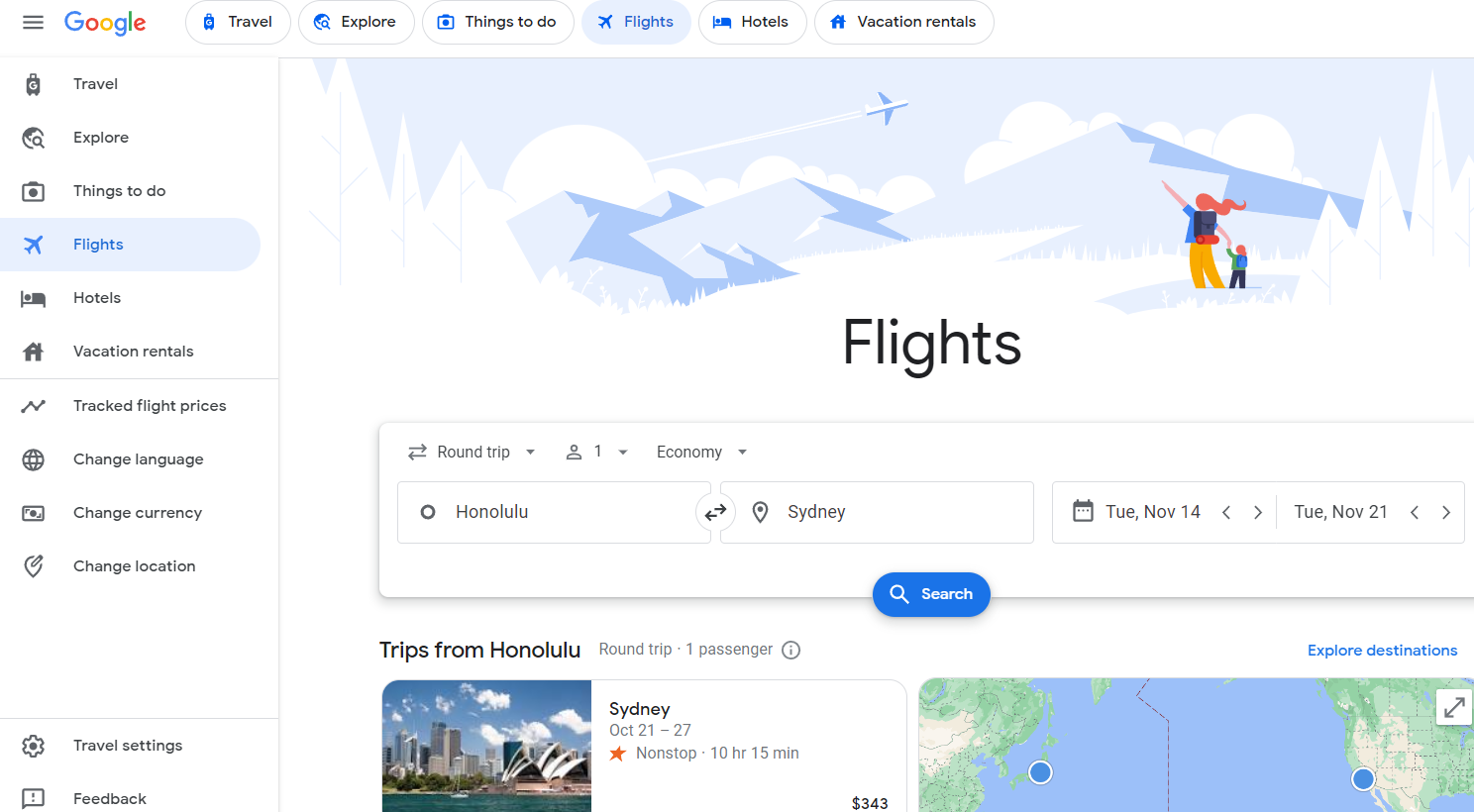
On the home screen you fill in the flight search:
- Departure airport. Up to seven different origins, so you can compare several starting points at once.
- Destination. Likewise up to seven, so you can compare where you land.
- Dates. Fixed dates or a range, depending on how flexible you are.
- Trip type. Return, one-way, or multi-city.
- Passengers. Adults, children, infants in seats and infants in laps, so the fares you see are the ones you would actually pay.
- Cabin class. Economy, premium economy, business or first. There is no dedicated Basic Economy filter, but the bags filter below is a good workaround.
Filters Worth Using
Filters are where most of the value is. The ones that matter:
- Airlines. Narrow to specific carriers or to an alliance such as SkyTeam, Star Alliance or Oneworld. Useful if you have status, or if you want to fly a particular airline.
- Bags. The most underrated filter. Adding a carry-on bag keeps fares that include one and drops the ones that don't, which quietly filters out most basic economy and budget carrier fares. It is the fastest way to compare like with like.
- Price. Set a ceiling and everything above it disappears.
- Times. Departure and arrival windows, for when you need to land before a certain hour.
- Stops. Including nonstop only.
- Emissions. Show lower-carbon options first.
- Connecting airports. Choose which airports you connect through, or exclude punishing layovers.
- Duration. Cap the total journey time.
- Separate tickets. Under "All filters", scroll to the bottom to remove itineraries that put your outbound and return on separate tickets.
Google Flights also shows the price difference between fare classes, so you can see what basic economy is actually saving you before you choose it.

Booking Direct
The main reason to like Google Flights is that you can book straight with the airline, with no intermediary. Buying through other flight search engines a few times is usually enough to put you off, between the added fees and the customer support.
Unlike agencies or third-party engines such as Kayak, Expedia or Priceline, Google Flights hands you to the airline. At the final step you are sent to the airline's own website, or to other sites that hold the same fare. Click "Select" and Google takes you to the deal you found, so you can book it directly.
Finding the Cheapest Days
Finding a cheap flight usually comes down to flexibility, and this is what Google Flights is best at.

It starts with the calendar view, which breaks down fares across a two-month window. Dates shown in green are the cheapest.
Google goes further than that. If shifting your trip by a day or two would save real money, it tells you so with a pop-up.
Click the date grid and you get a colour-coded chart of departure and return combinations. Sometimes a small shift saves a few tens of dollars. Sometimes it saves hundreds.
Is It Actually a Good Deal?
Flight prices move for all sorts of reasons, so it is hard to know whether what you are looking at is good. Google answers this directly. Select a flight and scroll down, and you get a chart comparing your price against the usual fare for that route, drawn from a very large history of fares.

Google also runs a price guarantee on some fares: if the price drops after you book, it refunds the difference, capped at $500 per calendar year.
There is a significant catch. The price guarantee is not available on most fares. It has stayed a limited pilot since launch, covering only selected flights departing the United States, and you have to book through Google's own checkout with Google Pay set up. Treat it as a bonus if it appears, not something to plan around.
The Explore Map
Sometimes you don't know where you want to go. This is what Explore is for, and it is the best way to find a cheap trip when the destination is negotiable.

To use it well:
- Enter your departure city and pick a destination as broad or as narrow as you like: Europe, Spain, Australia, or one city.
- Choose fixed dates or flexible ones. Prices vary a lot, so it pays to experiment. If your dates are firm you can search as far ahead as you want; if not, keep it inside the next six months.
- Move the map around to compare destinations and their prices side by side.
- When something catches your eye, click the city name and then "View Flights" to load the full search.
- Watch for fares in green, which marks the lowest airfare for the dates or trip length you are considering.
The Bottom Line
Google Flights is the best place to look at a route. Nothing else shows you as many dates as fast, the multi-airport search and the Explore map genuinely find trips you would not otherwise have found, and booking straight with the airline saves you a category of problem that agencies create.
It is not the best place to find every fare. Agencies negotiate discounted fares that never reach Google, a handful of airlines still sit outside the search engines entirely, and fares can vanish between the search page and the checkout. So use it as your first look and your date-finding tool, then check the airline's own site before you commit, and set an alert on the route rather than searching it over and over. The fare you want usually turns up when you aren't watching.
Published: July 14, 2023
Updated: September 9, 2026