
Budget-Travel : Best Travel Apps For Europe
If you've got Europe in your travel plans, be sure to know these must-have travel apps. They're designed to maximize your time, minimize your expenses, and have the best travel experience.

By Eglė
Published: September 25, 2023 • 10 min read
Updated: September 14, 2026
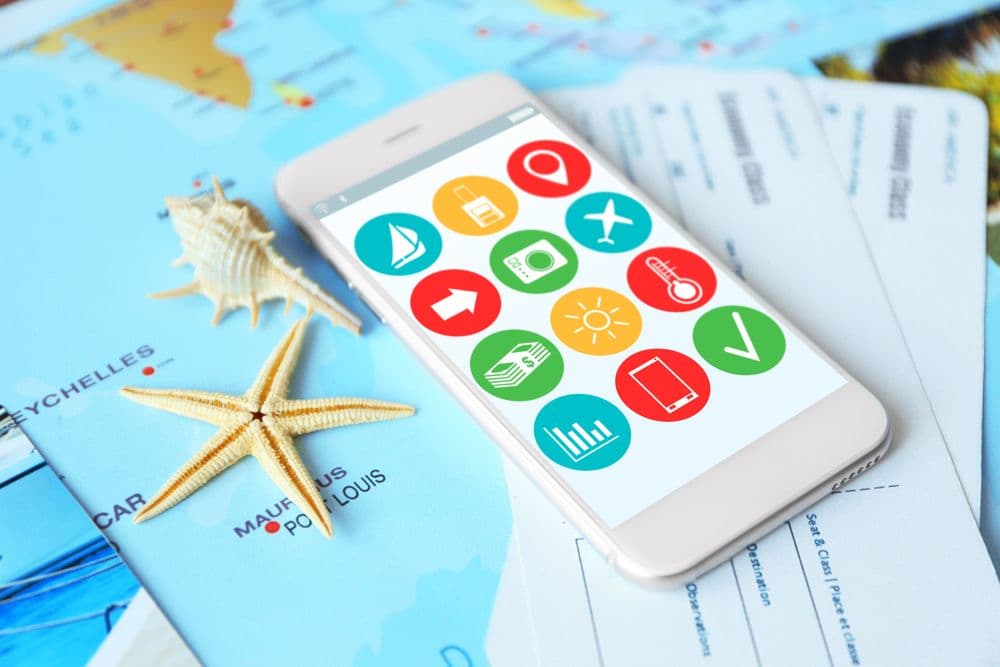
Traveling Europe cheaply comes down to a few things: buses instead of trains, hostels instead of hotels, a card that doesn’t charge you for spending abroad, and knowing where the cheap food is. All of it gets booked on a phone.
Here is what each app does, what it costs, and where it stops working.
Finding a cheap flight
Three ways to get a cheap flight: search for one, watch the price move, or be told when it drops.
1. Skyscanner
Skyscanner is a flight search engine. You put in your dates and it shows you what every airline and booking site is charging.
- Use it for - the Everywhere search, which shows you the cheapest places you can fly from your airport when you have dates but no destination in mind.
- New since 2023 - it sells train tickets too, in the UK, Spain, Italy, Germany, France and the Netherlands.
2. Google Flights
Google Flights is Google’s version of the same thing. It finds the same flights, and it is better at showing you how the price moves through the year.
- The price graph - shows what your route has cost month by month, so you can see whether your dates are the expensive ones before you book them.
- Explore - a map with prices on it, for when you have not decided where to go.
- Ignore the price guarantee - it only applies to flights leaving the United States, so it does nothing for a trip inside Europe.
3. RatePunk
RatePunk is our own flight deals app. You pick the airport you fly out of rather than a destination you already have in mind.
- What you get - alerts for cheap flights from your airport, including the mistake fares that vanish within a few hours.
- Cost - free, on iPhone and Android.
Getting between cities
These find your options between two cities, and price the train against the bus, the ferry, and a seat in someone’s car.
4. Omio
Omio sells tickets for trains, buses, ferries and flights in one place. You search a route and it shows you all four, with the price and the journey time for each.
- Use it for - the choice that saves the most money in Europe, which is usually bus against train rather than which airline to fly.
- Worth knowing - Omio owns Rome2Rio, the next app on this list, so checking both is not a second opinion.
5. Rome2Rio
Rome2Rio tells you how to get from any place to any other place. It lists every route it can find, then sends you elsewhere to book.
- How it differs from Omio - Rome2Rio is for working out what is possible, and Omio is where you buy. Omio bought Rome2Rio in 2019 and kept both.
- Best for odd journeys - it covers 240 countries, and it will find you a ferry, or a local bus that no flight search knows about.
6. FlixBus
FlixBus runs long-distance coaches across 35 European countries. It is usually the cheapest way to get from one city to the next.
- On board - Wi-Fi, a socket and a toilet, though Flix says the Wi-Fi and the sockets depend on the bus rather than being guaranteed.
- What it costs you - time. A bus can be €20 cheaper than the train and five hours slower, which is worth it on a short hop and rarely worth it overnight.
- The green part is real - Flix says a coach puts out about five times less carbon per passenger than a car, and ten times less than a plane.
7. BlaBlaCar
BlaBlaCar is car sharing between cities. Someone already driving from Lyon to Turin sells the empty seats in their car, and you pay a share of the trip instead of buying a ticket.
- Where it works - 41 countries, after a 2026 expansion that added Greece, Bulgaria, Albania and most of the Western Balkans.
- It sells more than car seats now - train tickets in France and Spain, and bus tickets from other companies, though its own French bus service closes at the end of 2026.
- Read the reviews first - you are getting into a stranger’s car for a few hours, and what other passengers wrote is what you have to go on.
8. Tripline
Tripline draws your trip on a map. You add the places you are going, and it joins them into a line you can look at.
- Use it for - spotting the backtracking. A trip that looks sensible as a list of cities can look ridiculous as a line.
- Cost - free, with a paid tier added in December 2025 for importing GPS tracks.
Getting around a city
These get you across a city, either on public transport or in a taxi. None of them covers all of Europe, so check yours before you land.
9. Citymapper
Citymapper gives you directions on public transport inside a city. It tells you which train to get, which exit to leave by, and how long you are walking at each end.
- Coverage - about 430 cities worldwide, so check that yours is one of them before you rely on it.
- Offline - journeys you have saved, and the local metro maps, work without a connection. Search your route while you still have Wi-Fi.
- It does not sell you the ticket - you buy that from a machine or the city’s own app, and a day pass only beats single tickets after about three rides in Berlin and close to six in Rome.
10. Google Maps
Google Maps is the map you already have on your phone. Two things about it matter on a trip: you can download a city and use it without data, and the reviews are the quickest way to tell whether a restaurant is any good.
- Download the city before you go - you pick an area, it saves, and it updates itself whenever you are on Wi-Fi.
- But offline gives you driving directions only - no buses, no trains, no walking routes. In a European city that is the opposite of what you need, so plan on having mobile data rather than relying on the download.
11. Uber
Uber is a taxi app. You book and pay on your phone, and you see the price before you get in, so there is nothing to argue about at the end of the ride.
- Where it is not - Uber does not list Bulgaria, Latvia, Iceland, Cyprus or most of the Western Balkans, so do not land somewhere expecting it.
- The Baltics are split - Estonia and Lithuania have Uber, Latvia does not.
12. Bolt
Bolt is an Estonian taxi app that works the same way as Uber. It usually costs less, and it operates in a lot of cities Uber never entered.
- Coverage - more than 850 cities in over 50 countries.
- Not only cars - scooters, e-bikes, rental cars and food delivery are all in the same app, and a scooter is often the cheapest way across a small city center.
Sleeping, eating, and paying
Where to sleep, how to eat for a few euros, and what to pay for both with.
13. Hostelworld
Hostelworld is where you book hostels. It lists about 17,000 of them in more than 180 countries, and every one carries reviews from people who stayed there.
- Not only dorms - most hostels also sell private rooms, often for less than a budget hotel on the same street.
- The social part - the app has chat and Linkups, which are things other guests are doing that evening. On a solo trip it is the fastest way out of your own company.
14. Too Good To Go
Too Good To Go sells food that bakeries, cafes and supermarkets have not sold by closing time, at about a third of the normal price.
- What you get - a Surprise Bag. You reserve a bag and a pickup time, not a menu, so you find out what is in it when you collect it.
- Where it works - about fifteen European countries. Not Finland, not the Baltics, not Greece, and not much of central or eastern Europe beyond Poland.
- Check the pickup time - it is usually a half-hour window at the end of trading, so your evening has to fit around it.
15. Revolut
Revolut is a bank account and card built for spending abroad. It changes your money at close to the rate you would see on Google, rather than the rate a bank gives you.
- The free plan has a ceiling - you can change £1,000 a month, and anything above that costs 1%.
- Weekends cost more - a 1% charge applies from Friday evening to Sunday evening, which covers most weekend trips.
- Cash is limited too - five cash withdrawals or £200 a month are free, and after that it is 2%.
- Always pay in the local currency - when a card machine offers to charge you in your own instead, that conversion adds 3% to 12% on top, whatever card you are holding.
Finding something to do
What is on this week, how to get into it, and who to meet while you are there.
16. Time Out
Time Out is a city guide written by people who live in the city. It covers what is new, what is open, and what is on this week, in more than 350 cities.
- Read it on the web - Time Out stopped making a city guide app, so bookmark your city’s page rather than looking for a download.
- Use it for - what is happening while you are there, which is the one thing a guidebook cannot tell you.
17. Free Tours
Free Tours is a booking site for walking tours that cost nothing to reserve. You turn up, take the tour, and pay the guide at the end whatever you thought it was worth.
- How the money works - tips are the guide’s whole income, so the going rate ends up close to what a paid tour costs. Walking off without paying is the thing not to do.
- Alternatives - GuruWalk runs the same model in more than 800 cities, so check both for wherever you are.
If you want one city to try this in, our guide to Lisbon covers the walk most people take there.
18. GetYourGuide
GetYourGuide sells tickets to museums, attractions and day trips. You buy in advance and walk past the ticket line.
- Use it for - anything with a timed entry, because the alternative in August is standing in line for two hours.
- Check the museum’s own site first - the same ticket is often a few euros cheaper direct, and the difference is what you pay for booking to be easy.
- Check the date as well - Italy’s state museums are free on the first Sunday of every month, and the UK’s national museums are free every day.
19. Tandem
Tandem is a language exchange app. You find someone who speaks the language you are learning and wants to learn yours, and you teach each other.
- Cost - free to message. The paid tier adds calls, unlimited translation, and more new people per day.
- On a trip - message someone in the city you are going to before you get there. It is an easier way to meet a local than a bar.
What to install before you go
If you only install four, cover the four things that cost you money: getting there, getting around, paying, and eating. That means Skyscanner or Google Flights, Citymapper or Google Maps, Revolut, and Too Good To Go. The rest are worth it on a longer trip.
We watch flight prices from your airport and tell you when one drops, so you don’t have to check every week. See the current deals from your airport.
Published: September 25, 2023
Updated: September 14, 2026