Upgrade Your Trip: Unusual Things to Do in Lanzarote
Explore hidden corners of sunny Lanzarote, a small island packed with diverse activities. Hike volcano craters, dive to underwater sculpture museums, and uncover secluded bays. Discover caves, local villages, and vibrant markets. As the fourth largest Canary Island, its unique terrain offers wild beauty, from dry hillsides to clear blue bays. For an extensive list of unique Lanzarote activities, consult our guide.
By Eglė
Published: August 29, 2023 • 12 min read
Updated: September 14, 2026
Lanzarote is the driest of the Canary Islands. Under 150 millimeters of rain falls in a year, there are no rivers, and a quarter of the island lies under lava from an eruption that ran for six years from 1730. That is why the best of it is nowhere near a beach: vines grown in pits dug through black ash, concert halls inside collapsed lava tubes, a sculpture museum on the seabed.
You will need a rental car, because the buses do not go to most of these places. Three of them sell timed tickets that run out in summer, and one free walk takes bookings a month ahead, so it pays to plan before you fly.
1. Visit the Cactus Garden
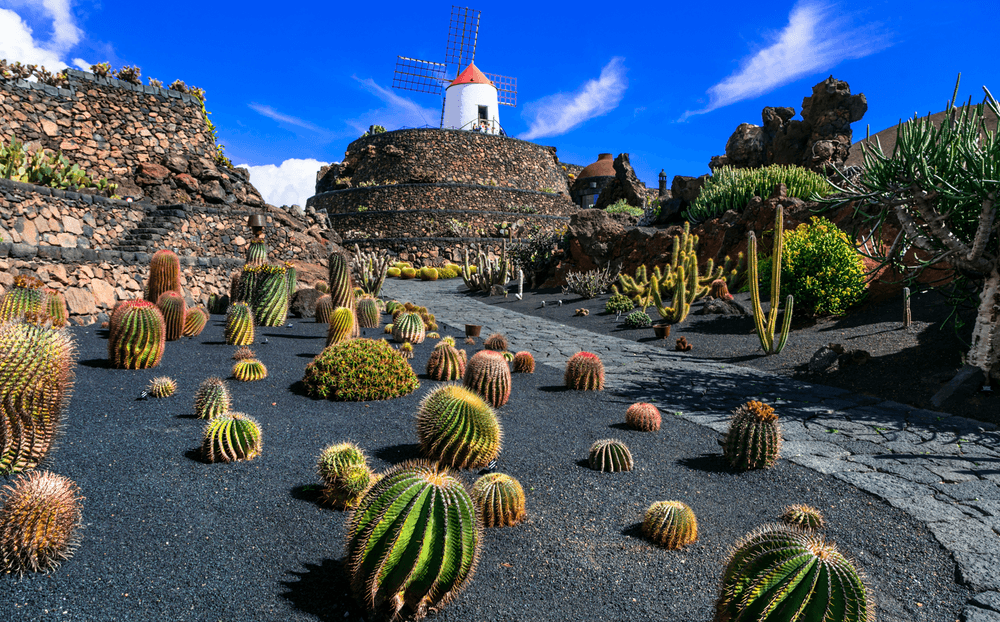
The Jardín de Cactus sits in a worked-out quarry that once supplied picón, the black volcanic gravel farmers here spread over their fields, in the middle of the island’s largest prickly pear plantation. César Manrique terraced it into an amphitheater of some 4,500 plants across nearly 500 species, and it was the last large thing he built on Lanzarote. A restored grain mill stands at the top, and the restaurant serves a highly rated cactus burger.
Before you go - €9, daily 10:00 to 17:00, last entry 16:30. An hour is enough.

2. Hiking in Timanfaya National Park
Timanfaya is the ground the 1730 eruption left, and you cannot walk around it as you please. The Montañas del Fuego are closed to visitors on foot; the way through is the Ruta de los Volcanes, a 12-kilometer coach route included in the ticket. The geysers at the Islote de Hilario are made on the spot: staff pour cold water into a borehole and it comes back as steam, because the ground runs over 100°C at the surface and around 600°C thirteen meters down. The same heat cooks lunch at El Diablo, on a grille Manrique hung over a fissure.
There is real walking, but you have to arrange it. Two guided routes, Tremesana and the Ruta del Litoral, are free, take about eight people, and open for booking a month ahead.
Before you go - €30 with a timed slot booked online, €15 for ages 7 to 12. Camel rides at the Echadero are €11 for twenty minutes, and a welfare campaign against them has passed 40,000 signatures.

3. Explore Jameos del Agua’s Caves
A jameo is what you get when the roof of a lava tube falls in and leaves a hole down into the tunnel. Manrique built a restaurant, a garden, and an auditorium inside three of them, using the cave for the acoustics. The saltwater lagoon at the bottom holds Munidopsis polymorpha, a blind white crab a centimeter long that lives here and nowhere else on Earth and is listed as endangered.
The white pool outside is not for swimming. Bathing in it is banned, and the fines run from €600 to €3,000 for the tourists who try anyway.
Before you go - from €17, daily 10:00 to 18:00, last entry 17:15. Noches de Jameos, dinner and a concert beside the lagoon, runs Fridays at €98.

4. Visit the César Manrique Foundation
Manrique built his house on five volcanic bubbles left in the 1730 lava and joined them with tunnels cut through the rock. The upper floor is a white Canarian house; the lower floor is the bubbles themselves, planted with fig trees, with a pool and a small dance floor down among the lava. He lived here twenty years before moving north to Haría.
Before you go - €10, daily 10:00 to 17:30. A combined ticket with his Haría house is €17.

5. The Pirate Museum in Santa Barbara Castle
The castle stands on the rim of the Guanapay crater above Teguise, which was the island’s capital until the government moved to Arrecife in the mid-19th century. Being the capital is why the raiders came. Murat Reis took the castle in 1586 after two assaults, burned the island’s records, and left with two to three hundred captives; in 1618 Tabac Arráez arrived with 36 galleys and around 900 people were carried off. Islanders hid from raids like these in the lava tube at Cueva de los Verdes.
Teguise reopened the castle in February 2025 and is turning the Museo de la Piratería into a museum of the town’s own history, so the displays and the price are both in flux.
Before you go - currently open 10:00 to 15:00. Phone Teguise on 928 59 48 02 to check what is on show.
6. Learn Myths and Stories Enclosed in Cueva de los Verdes
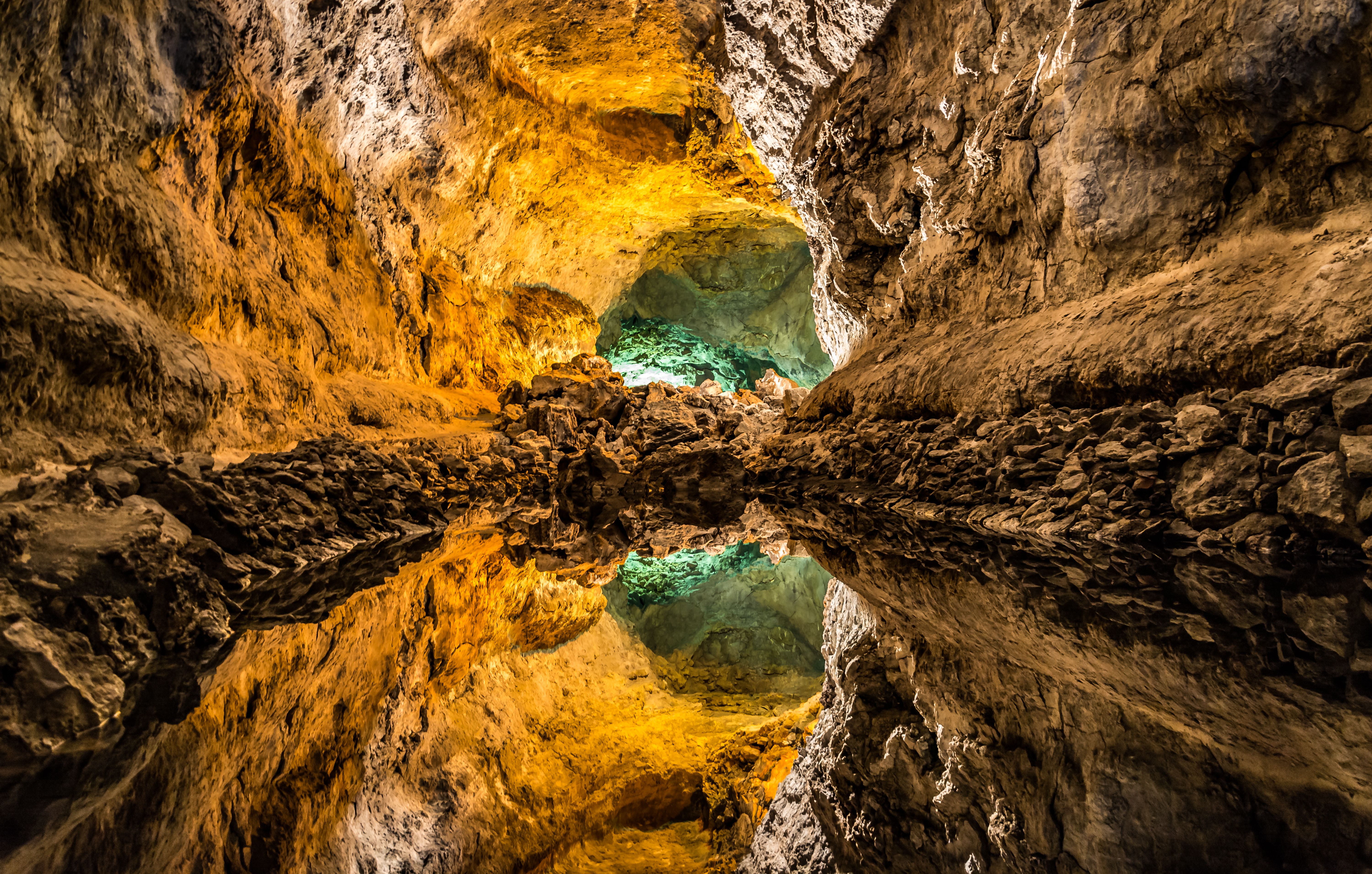
Cueva de los Verdes is a kilometer of walkway inside the La Corona lava tube, which formed around 20,000 years ago and runs more than seven kilometers to the sea. Local people used these galleries to hide from the North African raids of the 16th and 17th centuries. The guided tour takes about fifty minutes and ends in a chamber used as a concert hall, where the Cabildo programs classical, jazz, and flamenco through the year. The lighting is Jesús Soto’s, and it does most of the work.
Before you go - €17, daily 09:30 to 16:45. Timed slots are booked online and compulsory.

7. Time Out at Rancho Texas
Rancho Texas is a zoo in Puerto del Carmen with a water park attached, called Aqua Rancho, and the pools and slides come with the ticket. The animals include a white tiger, American bison, six-banded armadillos, Eurasian lynx, and two species of sea lion, with bird of prey and macaw shows through the day. Swimming with sea lions is sold separately at about €125, for ages seven and up.
The park also keeps four bottlenose dolphins, brought from German zoos in 2016, and the dolphinarium has drawn steady opposition since. Rancho Texas belongs to neither EAZA nor the Spanish zoo association AIZA.
Before you go - €45 adult, €30 for ages 3 to 12, daily 09:30 to 17:30. Free shuttle from Puerto del Carmen.

8. Take a Selfie Next to El Golfo’s Green Lagoon
El Golfo is half a volcano. Explosive eruptions built the cone where magma met seawater, and the Atlantic has since eaten the seaward side away, leaving an amphitheater open to the ocean with a green lagoon in the floor of it. The color comes from algae and aquatic plants growing in water far saltier than the sea, which seeps in underground through the gravel bar.
You look at it from above, and that is all. Swimming is banned, the black beach below is fenced, and the path down is closed. From the free car park it is a five-minute walk on a dirt track to the viewpoint.
Before you go - free and always open. Late afternoon is the best light, because the whole thing faces west.

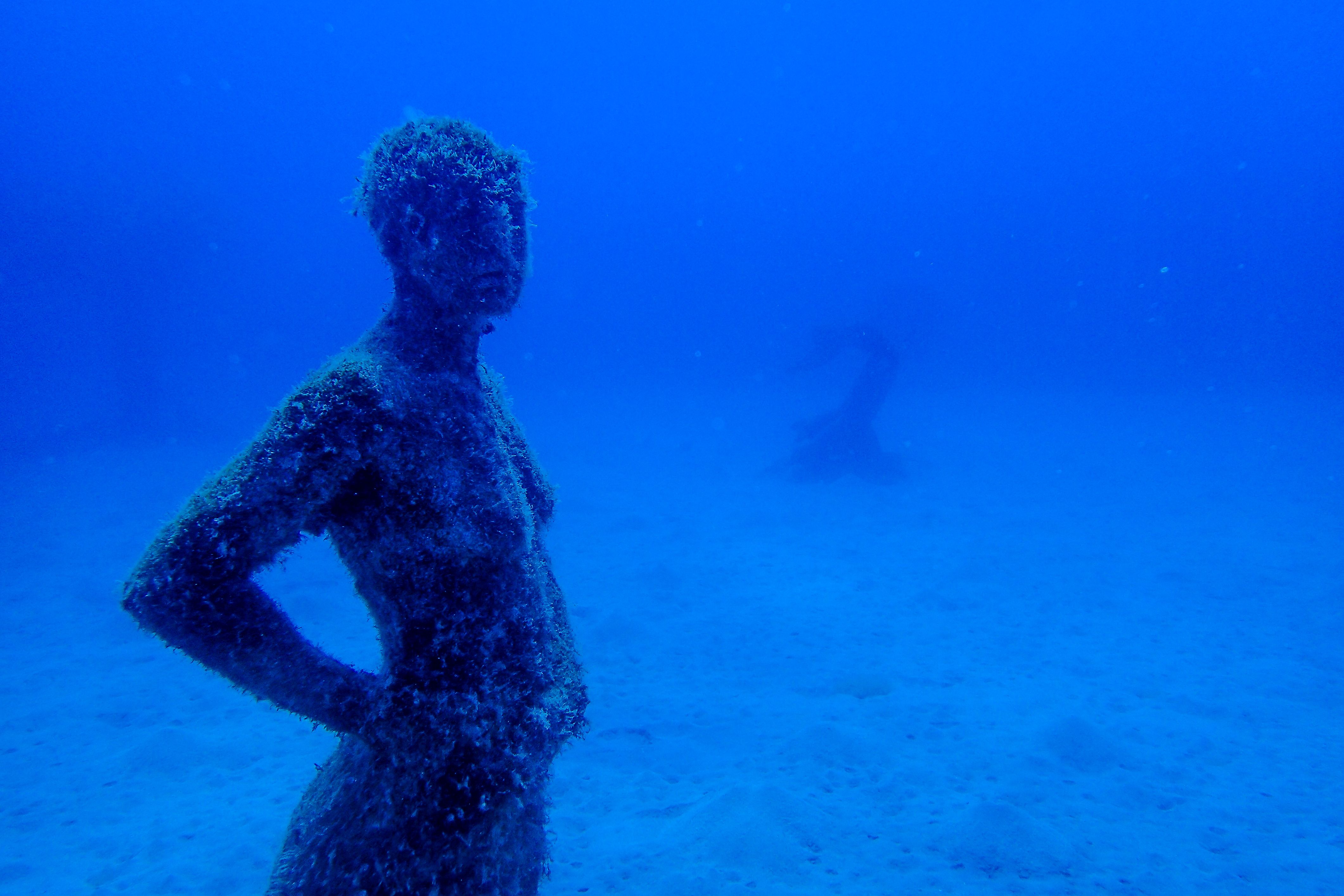
9. Extraordinary Visit to Museo Atlántico
Jason deCaires Taylor sank more than 300 concrete figures onto bare seabed off Playa Blanca in 2016, arranged in ten installations, and Museo Atlántico opened as Europe’s first underwater sculpture museum. It is no longer the only one: the same sculptor built MUSAN in Cyprus in 2021, and Marseille, Cannes, and Monte Argentario followed. The cement is pH-neutral and the whole thing was designed as an artificial reef, which has worked. Angel sharks, barracuda, octopus, and rays live on it now.
You have to dive it. The sculptures sit at 12 to 14 meters in a restricted zone that does not allow snorkeling, so there is nothing to see from the surface. Certified divers pay from around €50 for the boat trip, and the dive centers run a supervised introduction for beginners at about €149.
Before you go - book through a Playa Blanca dive center. There is no central ticket desk.

10. Soaking in Los Charcones
Los Charcones is a string of lava pools on the coast a few kilometers north of the Pechiguera lighthouse, some deep enough to swim in, some the size of a bath. It is also the most dangerous place on the island to get into the water. Three people died there between August 2025 and January 2026, the last a 21-year-old American tourist swept off the rock on a day the coast was under an orange warning for high seas. In November 2025 a single wave took four tourists off at once. There are no lifeguards, and the rescue rings that get installed keep being stolen.
Go on a calm day at low tide, when the swell is not washing over the rim, and not at all while a coastal alert is running.
Before you go - free. The last few kilometers are unsignposted dirt track with deep potholes, so park where the ground gets bad and walk in. Take shoes with grip.

11. Sip, Think & Enjoy: Take a Wine Tour Around the La Geria Vineyards
La Geria is not green. It is a valley of black ash where every vine sits alone in a pit about three meters across and two deep, with a curved wall of lava stone on the windward side to hold the trade wind off it. The ash traps night dew and keeps it, which is how a crop grows on under 150 millimeters of rain a year with no irrigation. Lanzarote never got phylloxera, so the vines are ungrafted and many are well over a century old, and the grape is Malvasía Volcánica, a cross that appeared here and grows almost nowhere else.
El Grifo, founded in 1775, is the oldest winery in the Canaries, with a wine museum in the original buildings and tastings from €15. Bodega La Geria runs guided tours daily. Both sit on the LZ-30, the road the valley is strung along.
Before you go - the LZ-30 is a busy road with no cycle lane. Drive it, and save the walking for the marked paths off it.

12. Ain’t No La Corona Volcano High Enough
La Corona is 609 meters high, with a crater about 450 meters across and 200 deep, and the path up starts at the hermitage in Yé. It is roughly three kilometers there and back and takes most people an hour and a half to two and a half hours, not the forty-five minutes it usually gets credited with. You cannot go down inside the crater: the rim is signed against it and the ground is loose.
What is underneath is as good a reason to climb it as the view. The eruption, roughly 20,000 to 25,000 years ago, poured the lava tube that holds Cueva de los Verdes and Jameos del Agua. It runs more than seven and a half kilometers and continues for a final 1.6 kilometers below sea level as the Túnel de la Atlántida, the longest submarine lava tube known.
Before you go - free. Guided walks link the climb to the Famara cliff path, about eight kilometers and three and a half hours.

13. Beaches Beaches Beaches
Lanzarote’s beaches are not interchangeable, and the wind usually decides which one you want. Six held a Blue Flag in the 2026 season, all on the sheltered east and south coasts.
- Papagayo - sandy coves inside the Los Ajaches natural monument, reached by 5.5 kilometers of dirt track from Playa Blanca. €3 per car for non-residents, card only, barrier open 09:00 to 19:00.
- Famara - the surf beach under the cliffs on the northwest coast. It carries an official bathing caution and the rip currents are strong, so surf it or walk it, but do not swim.
- Playa Blanca - town beaches with a promenade of restaurants behind them and the Fuerteventura ferry at one end. Blue Flag.
- Caletón Blanco - white sand scattered over black lava east of Órzola, with shallow turquoise pools between the rocks. Best at high tide, and the easiest with small children.
- Playa de los Charcos - a calm bay in Costa Teguise held between two lava breakwaters, with parking behind it.
- Playa Quemada - black sand and a few seafood restaurants in a fishing village on the southeast coast, out of the wind behind the Los Ajaches hills.
- Playa de las Conchas, La Graciosa - 600 meters of sand on the island across the strait, 25 minutes by ferry from Órzola. Red flags fly most of the year and the currents pull hard, so wade rather than swim.
- Matagorda - wind almost every day, which is why the windsurfers are there, and directly under the approach to the airport. Blue Flag.
What to Book Before You Fly
Three things need to be arranged from home. Cueva de los Verdes and Jameos del Agua both sell timed slots online and fill up in summer, and the free guided walks in Timanfaya open about a month out and take eight people at a time. Museo Atlántico you can usually sort out with a dive center once you land.
For the rest, a car and three or four full days will cover it. Lanzarote is only sixty kilometers end to end, but Papagayo, Los Charcones, and La Graciosa all finish on dirt track or a boat, so the distances lie.
Fares in Arrecife swing a lot between seasons, and the gap between a good week and a bad one is usually wider than anything you will save once you are there.
RatePunk watches prices from your home airport and tells you when one drops, so you can pick the week around the fare instead of the other way round.
If Lanzarote is one stop on a longer trip, our seven-day Spain guide lays out a route you can finish in a week: Guide: 7-Day Trip to Spain.
Published: August 29, 2023
Updated: September 14, 2026