Singapore Airlines vs. Emirates in 2027 on Miles and Routes
Singapore Airlines vs Emirates comes down to routes, cabins, baggage and fees, and loyalty programs. See how the two compare and which suits your trip.

By Eglė
Published: November 30, 2023 • 5 min read
Updated: October 15, 2026
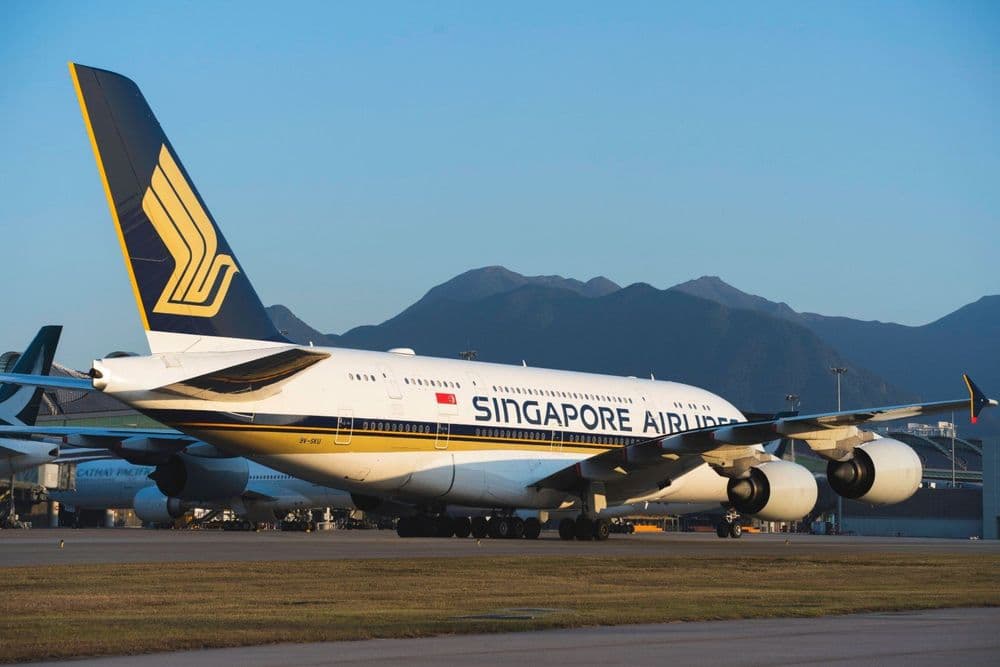
Emirates and Singapore Airlines are two of the best-known long-haul airlines in the world. Emirates flies out of Dubai and Singapore Airlines out of Singapore. Almost every route either airline flies runs through its home airport.
Picking between them comes down to four things:
- Where each airline flies
- What its cabins are like
- What you can bring with you
- Which loyalty program is worth your miles
Here is how they compare on each.
See Flight Deals from Your Home Airport
Where Each Airline Flies
Emirates wins
Emirates flies from Dubai to 137 destinations in 77 countries across six continents. Twelve of them are in the United States, including Boston, Chicago, and Dallas/Fort Worth. It belongs to no airline alliance. That has left it free to build its own network instead of feeding someone else’s, and everything runs through Dubai, so a passenger heading for Africa, the Middle East, or South Asia can usually get there with one stop.
Singapore Airlines, Singapore’s national carrier, serves 87 destinations. It has been a member of Star Alliance since 2000, so one ticket can carry you past those 87 to an airport Singapore Airlines does not serve, with another alliance airline flying the last leg. Star Alliance has 28 member airlines.
Emirates flies to more cities on its own planes. Singapore Airlines flies to fewer, and reaches the rest through the alliance.
Europe’s Budget-Friendly Airlines You Should Know
What You Get in Each Cabin
It’s a tie!
Emirates sells four cabins on international flights:
- Economy
- Premium economy — the newest of the four, introduced in December 2020
- Business — flat beds, a full meal service, and an onboard bar on the A380
- First — a private suite, a shower spa, and a chauffeur to and from the airport
Singapore Airlines sells five:
- Economy
- Premium economy
- Business — meals you can preselect, and seats that convert into a double bed on the A380
- First — seats that turn into flat beds
- Suites — an enclosed cabin on the A380, a class above first
The aircraft matters as much as the cabin name. Emirates flies an all-widebody fleet of A380s, A350s, and 777s, so every seat it sells is on a twin-aisle jet. Singapore Airlines flies a smaller and more mixed fleet, so the same fare can put you on very different hardware depending on the route. Check the aircraft type before you book either one.
How Many Bags You Get and What Extras Cost
It’s a tie!
Both airlines run two different baggage systems, and which one you get depends on where you’re flying rather than what you paid. On some routes you get a set number of bags, each with its own weight limit. On the rest you get one total weight and can split it across your bags however you like.
Emirates counts bags on flights to and from the Americas and Africa, and total weight everywhere else. On US routes:
- Economy, Special and Saver fares — 1 bag, 23 kg (50 pounds)
- Economy, Flex and Flex Plus fares — 2 bags, 23 kg each
- Business and first — 2 bags, 32 kg (70 pounds) each
Singapore Airlines counts bags on flights to and from the United States and Canada only. On those routes:
- Economy and premium economy — 2 bags, 23 kg each
- Business, first, and Suites — 2 bags, 32 kg each
Fly Singapore Airlines anywhere else and you get one total weight instead:
- Economy, Value and Lite fares — 25 kg
- Economy, Flexi and Standard fares — 30 kg
- Premium economy — 35 kg
- Business — 40 kg
- Suites and first — 50 kg
One rule holds everywhere. No single bag may weigh more than 32 kg, for the sake of the people who have to lift it.
Carry-on is one bag plus a personal item on either airline, with the bag around 22 x 15 x 8 inches (55 x 38 x 20 cm).
Fees are close enough to call even. Singapore Airlines charges less to pick a seat. Emirates charges less for an extra bag.
JetBlue vs Frontier: Pros And Cons
Which Loyalty Program Is Worth Your Miles
Singapore Airlines wins
Each airline runs its own frequent flyer program: KrisFlyer at Singapore Airlines and Skywards at Emirates. You collect miles when you fly and spend them later on free or discounted seats.
KrisFlyer is the simpler of the two, and the better value. The difference starts with how you get the miles. Skywards rewards you for flying Emirates: climb its tiers and each flight pays a bigger mileage bonus. KrisFlyer does not need you to fly at all, because several US credit card programs transfer points straight into it. A program you can top up from a card you already hold is worth more than one you can only fill by flying.
The difference carries over to spending them. KrisFlyer miles work across Star Alliance, including a Round the World award that circles the globe with stops along the way. Skywards has no alliance behind it, so Skywards miles only work on Emirates flights.
Which One Should You Book?
Emirates flies to more cities on its own planes. Singapore Airlines has the better loyalty program. Cabins and baggage are close enough on both that neither will decide it for you.
Which one to book:
- Emirates, if you’re heading for Africa, the Middle East, or South Asia, or you want a widebody on every leg.
- Singapore Airlines, if you’re collecting miles you can top up from a credit card you already hold, or you want Suites.
Past that, go by what changes from trip to trip: what the fare costs, when the flights leave, and how many stops you’re willing to take.
Whichever airline you choose, the fare depends on the airport you fly from. RatePunk keeps track of what flights from your home airport usually cost, and we alert you when one drops below that price.
Published: November 30, 2023
Updated: October 15, 2026