
Flights from Australia to Italy in 2027: Fares by Month and City
See how far ahead to book flights from Australia to Italy, which months cost the least, and why the main gateways usually cost less than smaller airports.

By Heather Budreviciene
Published: May 29, 2026 • 10 min read
Updated: October 15, 2026

By RatePunk Research · Updated 2026-05-29
The price of entering Italy
Australia to Italy is one of our most heavily trafficked long-haul corridors, yet travelers face a highly centralized pricing structure where Rome acts as a costly gateway. Our analysis of over 40 million flight searches reveals that trying to bypass the major hubs in search of secondary gateways yields virtually no relief from the long-haul markup.
Rome and Milan together swallow 84% of all Australian passenger volume to Italy. Because of Australia's extreme geographical isolation, airlines concentrate their capacity on these major hubs. This leaves smaller regional airports starved of competitive pressure. For example, routing into Venice or Bologna actually drives prices up, with Venice carrying a median round-trip fare of A$2,111—higher than both Rome and Milan.
Furthermore, the booking curve for this corridor is highly counter-intuitive. Our data shows that booking too early often backfires, as airlines price their initial seat releases defensively. For the best value, travelers must navigate a narrow booking window rather than rushing to lock in flights a year in advance.
See Flight Deals from Your Home Airport
The December peak and the February trough
The pricing curve for Australia-to-Italy flights is defined by a single, violent spike that exposes the centralized nature of this long-haul corridor. While European summer demand creates a sustained high-price plateau from June through October, it is the December peak that distorts the market entirely. During this month, the price index surges to 150.7—representing a massive 78.8% swing from the February trough.
This extreme volatility is driven by the collision of Australia’s statutory summer holidays with a highly centralized routing structure. One likely explanation is that travelers must funnel through a limited number of mid-point hubs to reach Rome or Milan. Though we would need carrier data to confirm, this concentration likely allows airlines to capture the surging seasonal demand.
For your trip planning, this means the traditional advice of booking as early as possible can backfire. On this corridor, airlines often price early inventory defensively high. Those booking eight months out frequently overpay.
To bypass this seasonal markup, avoid the December rush entirely and target February, when the index drops to its annual low of 71.9. If you must travel during the European summer, aim for the shoulder month of May rather than September, as late-summer demand keeps fall prices surprisingly high.

Monthly price index for flights from Australia to Italy. Index = 100 is the annual average. Peak: December (151). Trough: February (72).
Why booking early is a losing strategy
Securing a viable fare through the highly centralized Rome and Milan gateways requires discarding the conventional advice of booking as early as possible. While the typical median fare for a round trip from Australia to Italy sits at A$2,032, our search data reveals that booking a massive eight months in advance is actually a trap. Travelers booking 240 days out face a steep median of A$2,234. Those who rush to lock in plans early pay a substantial markup for their impatience.
Instead, the best strategy is to target the safer 60-to-120-day window. In this range, median fares soften to between A$1,894 and A$1,946 while still offering a reliable selection of routes. While the data shows an even lower median of A$1,701 at the 30-day mark, waiting this long is highly risky. This close-in dip is a statistical artifact of airlines clearing leftover, inconveniently routed inventory. While the price tag looks tempting, the actual choice of comfortable, single-transit flights collapses.
To further improve this window, look to depart on Sundays or Mondays. Weekend departures can push prices toward a weekly peak of A$1,984 on Saturdays. Use the 90-day mark as your decision threshold: secure a reliable mid-week routing then, rather than gambling on late-stage seat clearances.
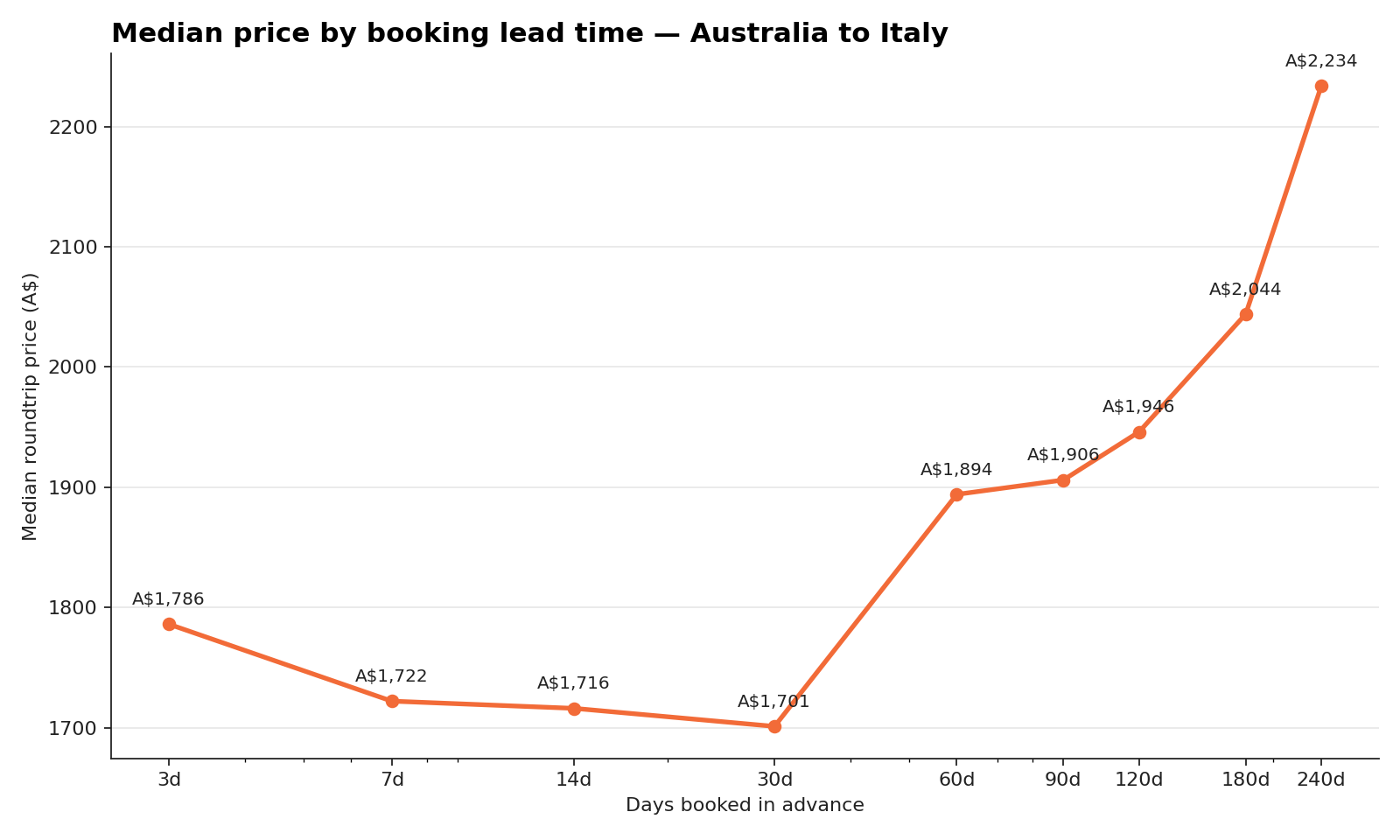
Median roundtrip fare by booking-window length (days before departure) for flights from Australia to Italy. Based on 1,020,220 search snapshots.
Where the flights actually land
Italy is a highly centralized aviation market for Australian travelers, with Rome and Milan absorbing a combined 84% of all route traffic. This extreme concentration creates a situation where secondary gateways offer no relief from the long-haul markup. In fact, attempting to bypass the major hubs by flying into regional airports like Bologna or Venice generally drives costs higher, with Bologna's median fare climbing to A$2,715, about A$750 more than Milan. The data reveals that the competitive pressure holding down the price floor is entirely confined to the two primary gateways. For travelers, trying to game the system with a secondary Italian arrival city is a losing strategy.
| Rank | City | Avg roundtrip | Median roundtrip | % of country searches |
|---|---|---|---|---|
| 1 | Rome | A$2,378 | A$2,056 | 52.8% |
| 2 | Milan | A$2,284 | A$1,964 | 31.2% |
| 3 | Venice | A$2,412 | A$2,111 | 6.9% |
| 4 | Bologna | A$2,711 | A$2,715 | 1.6% |
| 5 | Florence | A$2,472 | A$2,052 | 1.4% |
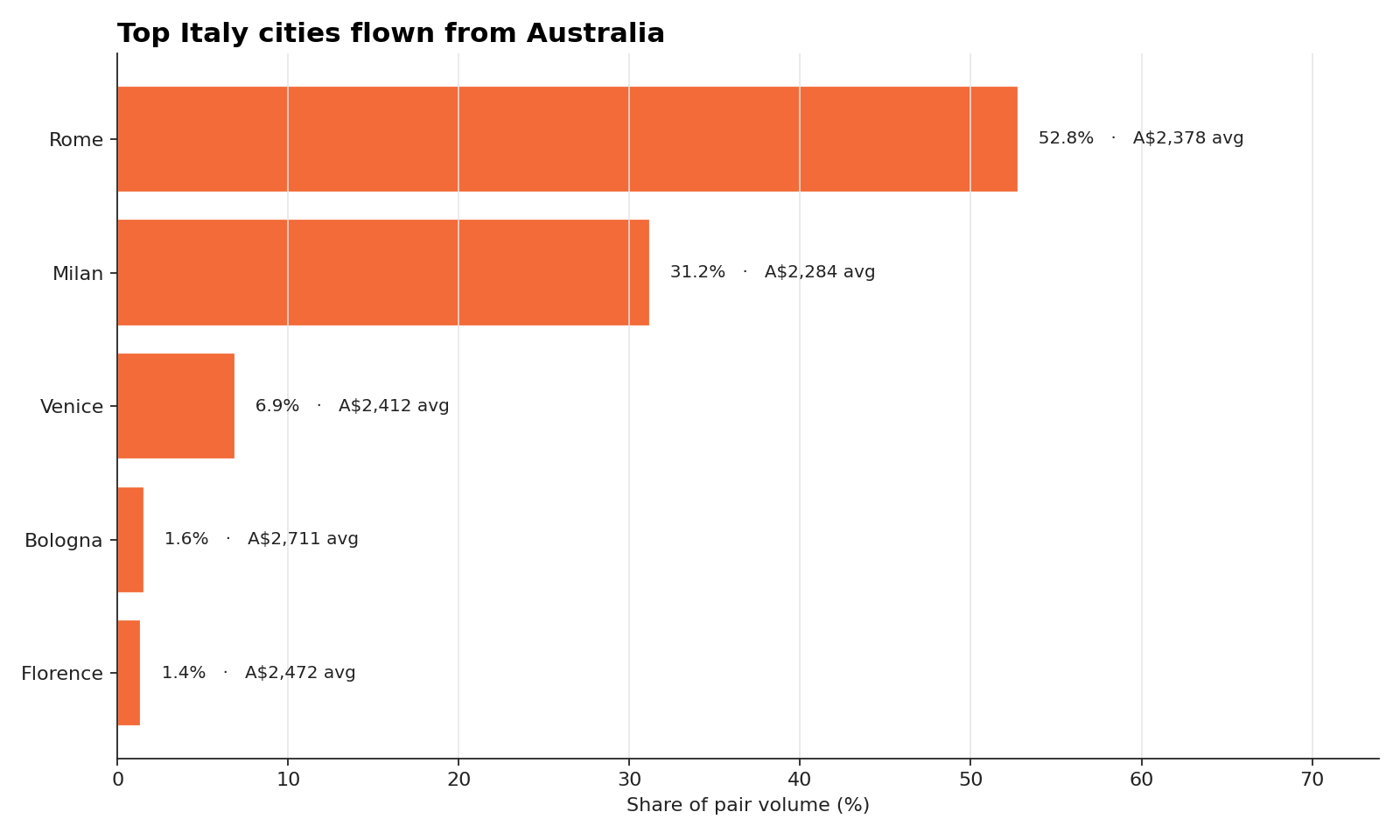
Top destination cities within Italy for flights from Australia to Italy. Fares show both the average and the typical (median) roundtrip; share figures are each city's percentage of the country's search volume.
The Rome bottleneck
Rome operates as the heavy gravity well of the Italian flight corridor, capturing 52.8% of all Australian outbound traffic to the country. Across more than 1.2 million searches in our dataset, Rome's Fiumicino Airport acts as the default gateway, yet this massive volume fails to translate into competitive pricing. The median round-trip fare to Rome sits at A$2,056, which actually exceeds the national median of A$2,032. Even Milan, the country's secondary hub, commands a hefty A$1,964 median.
What this means for your trip is that trying to bypass Rome by booking into secondary gateways like Venice or Bologna to find a bargain is a mathematical dead end. Venice fares jump to a median of A$2,111, while Bologna spikes to A$2,715. The high concentration of flights into Rome means airlines concentrate their competitive inventory there. Stepping off that beaten path simply exposes you to low-frequency, high-markup regional connections.
If you are planning an Italian itinerary, our recommendation is to accept Rome's central role rather than fighting it. Book your long-haul flight directly into Rome or Milan, and use Italy’s highly efficient high-speed rail network to reach regions like Tuscany or Veneto. Trying to force an all-air itinerary to a secondary city like Florence or Venice will almost certainly inflate your upfront ticket cost by hundreds of dollars without saving any actual travel time once layovers are factored in.
Which Australian cities pay the highest premium
No matter where you board in Australia, the flight path to Italy funnels into a rigid, two-city system that dictates your baseline ticket cost. Rome and Milan swallow up to 80% of all traffic from every major domestic gateway, leaving secondary destinations like Venice or Florence with virtually no direct pricing leverage. Perth serves as the sole geographic exception, squeezing under the two-thousand-dollar mark with a median fare of A$1,998, while east-coast travelers face a steep markup, topping out at A$2,302 in Brisbane and A$2,151 in Sydney. For your trip, this concentration means that trying to bypass the major hubs by booking directly into regional Italian airports is a mathematical trap. The lack of airline competition on secondary routes simply inflates the fare. Your smartest financial play is to buy the cheaper, highly contested ticket into Rome or Milan, and then use Europe's budget rail or regional carriers to reach your final destination.
Four bookings most travelers miss
- Gold Coast to Naples bypasses the standard Rome gateway with a massive 47.9% discount off the baseline, offering a rare sub-A$1,000 entry point to southern Italy (n=500 searches).
- Brisbane to Turin undercuts the northern hub markup by 26.7%, demonstrating that targeting Piedmont instead of Milan can yield significant savings (n=696 searches).
- Avalon to Milan provides a highly competitive alternative to Melbourne Tullamarine, shaving 25.9% off the standard long-haul baseline to Lombardy (n=1290 searches).
- Melbourne to Pisa offers a surprising 25.7% saving against the regional average, proving that secondary Tuscan gateways can occasionally break the rigid national pricing structure (n=1759 searches).
Frequently asked questions
What is the cheapest month to fly from Australia to Italy?
February is the cheapest month to fly, with a price index of 71.9, while December is the most expensive at 150.7. This represents a massive 78.8% seasonal swing in pricing, meaning a trip during the Christmas peak can easily cost double the February off-peak rate.
Which Italian city is the cheapest to fly into from Australia?
Milan (MXP) is the cheapest gateway, with a median round-trip fare of A$1,964 in our dataset. Flying into Rome (FCO) costs slightly more at a median of A$2,056, but it handles over 52% of all passenger volume, making it the primary gateway for Australian travelers.
Should I fly into a smaller Italian airport like Venice or Bologna to save money?
Usually not, because on average the smaller airports cost more. Venice (VCE) averages A$2,412, while Bologna (BLQ) climbs to a steep average of A$2,711—nearly A$350 more than the national average of A$2,364. Stick to Milan or Rome and use Italy's domestic rail network to reach your final destination.
How many days in advance should I book my flights to Italy?
Our data reveals a counter-intuitive curve where booking 240 days out yields the highest median fare of A$2,234, whereas the lowest fares of A$1,701 appear around 30 days prior to departure. However, we do not recommend waiting until the last month; this statistical drop likely reflects airlines dumping unpopular, multi-stop itineraries, meaning your route quality and seat selection will be severely compromised. For a reliable balance of price and routing, target the 60-to-120-day window.
Do Australian citizens need a visa to visit Italy?
No, Australian passport holders do not currently need a visa for short-term tourist stays. Australia ranks 7th on the Henley Passport Index with visa-free access to 182 destinations, allowing you to enter Italy and the wider Schengen Area for up to 90 days in any 180-day period without pre-arranging entry documentation.
When and Where to Book Your Flight to Italy
These four choices usually lower the fare from Australia to Italy.
- Book 60 to 120 days ahead — median fares in that window are A$1,894 to A$1,946, while booking 240 days out costs a median of A$2,234.
- Travel in February — the price index drops to its yearly low of 71.9, compared with 150.7 in December.
- Fly into Rome or Milan — the two cities have median fares of A$2,056 and A$1,964, below Venice at A$2,111 and Bologna at A$2,715.
- Leave on a Sunday or Monday — Saturday departures push the median up to its weekly peak of A$1,984.
Fares to Italy differ by about A$300 between Perth and Brisbane departures. RatePunk keeps track of what flights from your home airport usually cost, and we alert you when one drops below that price.
Our data methodology
This analysis is based on economy-class fare searches from RatePunk’s flight-price dataset, drawing from a broader global sample of 40,688,214 searches across 22,792 routes. The search records for this Australia-to-Italy corridor study were captured between August 5, 2025, and May 7, 2026, covering travel departure dates from August 5, 2025, through April 30, 2027. All prices are calculated and presented in Australian Dollars (AUD).
To ensure statistical clarity, our fare tables report both the average and the typical (median) price. The booking-timing and weekday figures are represented strictly as medians to prevent single markup fares from distorting the baseline, while the seasonality analysis uses an index where 100 represents the annual average.
Published: May 29, 2026
Updated: October 15, 2026