
Flights from Australia to Japan in 2027: When and Where to Book
Planning flights from Australia to Japan? See the cheapest and priciest months, when to book, how Tokyo compares with other cities, and visa basics.

By Heather Budreviciene
Published: May 29, 2026 • 10 min read
Updated: October 15, 2026

By RatePunk Research · Updated 2026-05-29
Key findings
The high cost of flying from Australia to Japan is an avoidable tax, not an inevitability. While the average ticket price across our search dataset sits at a steep A$1,379, the median fare drops to A$1,047—proving that most travelers are overpaying simply by booking at the wrong time or through the wrong hub.
This A$332 gap exists because Japan isn't a uniform market. Intense competition across regional Australian airports and a highly seasonal booking curve create sharp pricing anomalies. If you assume that booking as early as possible guarantees the best rate, you will likely pay the average markup. Finding the floor on this route requires targeting specific booking windows where airlines actively cut margins to fill seats. By understanding how regional hubs compete and how destinations like Osaka drop well below the national average, you can bypass the standard long-haul markup entirely.
See Flight Deals from Your Home Airport
The December peak and the June trough
The December peak for flights to Japan is an absolute outlier, driven entirely by the collision of Australian school holidays and the festive break. In December, the price index rockets to 173.1, nearly double the baseline of other months. This spike reflects a highly seasonal market where families are locked into a rigid travel window, forcing them to pay a massive markup.
What this means for your trip is that you should actively avoid the December-to-January crush unless you have no other choice. Instead, the shoulder and off-peak seasons offer dramatic, under-used savings. By June, the index drops to its lowest point at 65.5, with May close behind at 68.8. This smooth mid-year dip represents a massive discount window where airlines struggle to fill seats during the Australian winter, even though Japan is entering its lush green season.
Our recommendation is to skip the peak and target the May–June trough, where you can easily secure flights for a fraction of the holiday price. If you want to see the fall colors, aim for September or October, but book exactly 180 days out. Do not book eight months ahead expecting early-bird discounts; on this route, the best fares emerge in a strict medium-term window rather than to those who buy earliest.

Monthly price index for flights from Australia to Japan. Index = 100 is the annual average. Peak: December (173). Trough: June (66).
The 180-day sweet spot
The typical median fare for a round trip from Australia to Japan sits at A$1,047, but waiting for the optimal booking window reveals a highly specific sweet spot where prices drop significantly. Our analysis of over 3.3 million searches shows that booking 180 days out pulls the median fare down to A$855—the absolute cheapest point on the curve. This represents a substantial discount compared to the overall average fare of A$1,379, which is heavily inflated by late bookings and peak-season markups.
The data reveals a strict penalty for booking too early. Travelers who rush to lock in flights 240 days in advance face a median fare of A$1,362, paying a steep markup before airlines begin competing on the route. Conversely, waiting until the last month is a gamble. While the median fare hovers around A$1,090 at the 30-day mark, this close-in pricing is often a statistical trap. The slight dip from the peak does not represent a reliable discount; rather, it reflects a collapsing inventory of inconvenient, multi-stop itineraries that remain unsold.
To secure both a low price and a viable route, lock in your flights four to six months before departure. Within this window, you can optimize your savings further by choosing to depart on a Sunday (median A$921) rather than a Friday (median A$1,066), as the weekend departure spread is far more pronounced than the modest variation in booking days.
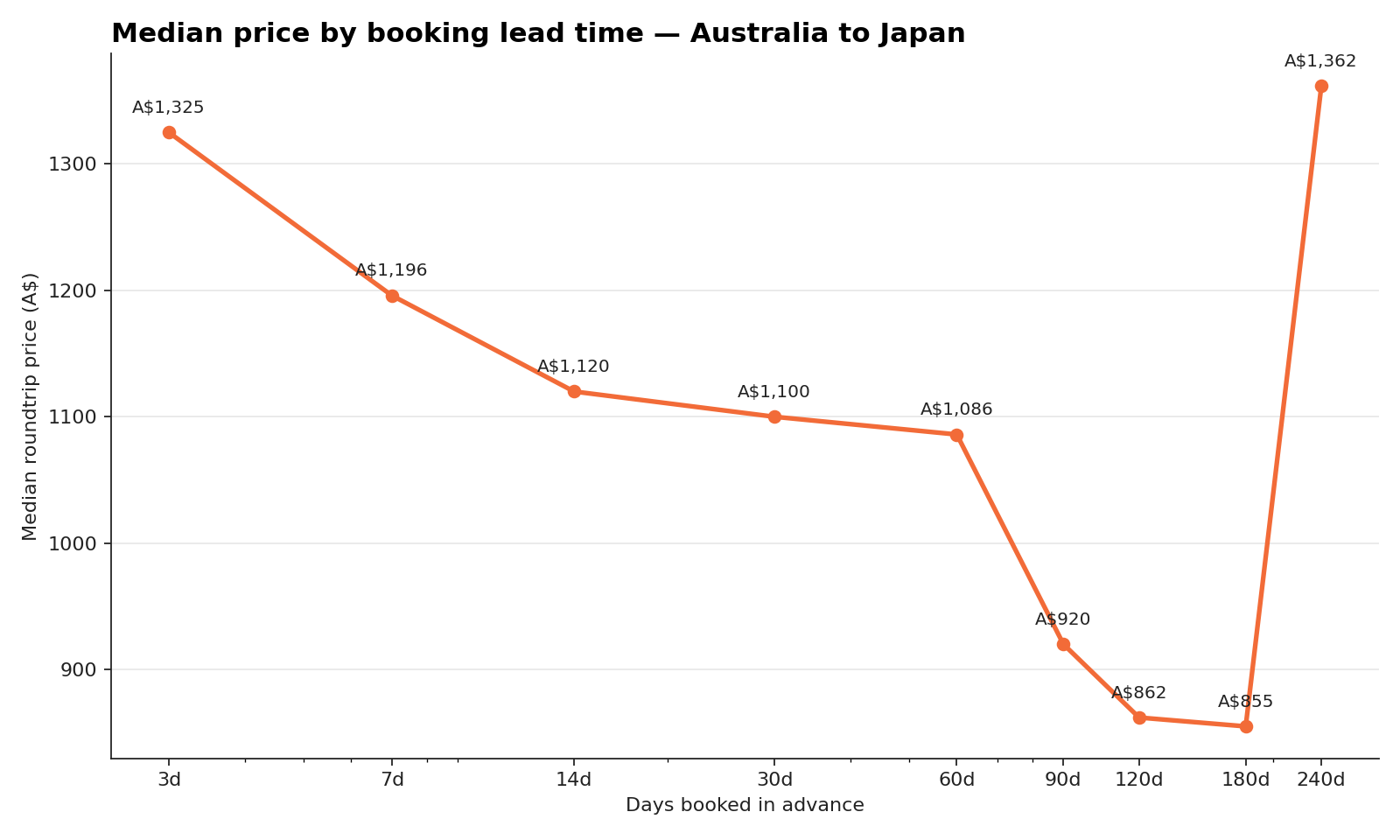
Median roundtrip fare by booking-window length (days before departure) for flights from Australia to Japan. Based on 2,389,020 search snapshots.
Where to fly into Japan
While Tokyo absorbs nearly two-thirds of Australian demand, paying the capital's A$1,437 average fare is not a structural necessity of traveling to Japan. Our search data reveals a split market where bypassing the dominant gateway yields immediate, predictable savings. Osaka stands out as a structurally cheaper entry point, carrying a median price of just A$892—a discount driven by intense low-cost carrier competition. For travelers willing to look beyond Tokyo, the price floor of a Japanese holiday drops dramatically. The following breakdown shows where Australian search volume concentrates and where the genuine pricing anomalies live.
| Rank | City | Avg roundtrip | Median roundtrip | % of country searches |
|---|---|---|---|---|
| 1 | Tokyo | A$1,437 | A$1,095 | 64.1% |
| 2 | Osaka | A$1,154 | A$892 | 24.3% |
| 3 | Sapporo | A$1,465 | A$1,218 | 3.8% |
| 4 | Fukuoka | A$1,424 | A$1,140 | 0.9% |
| 5 | Nagoya | A$1,492 | A$1,220 | 0.8% |
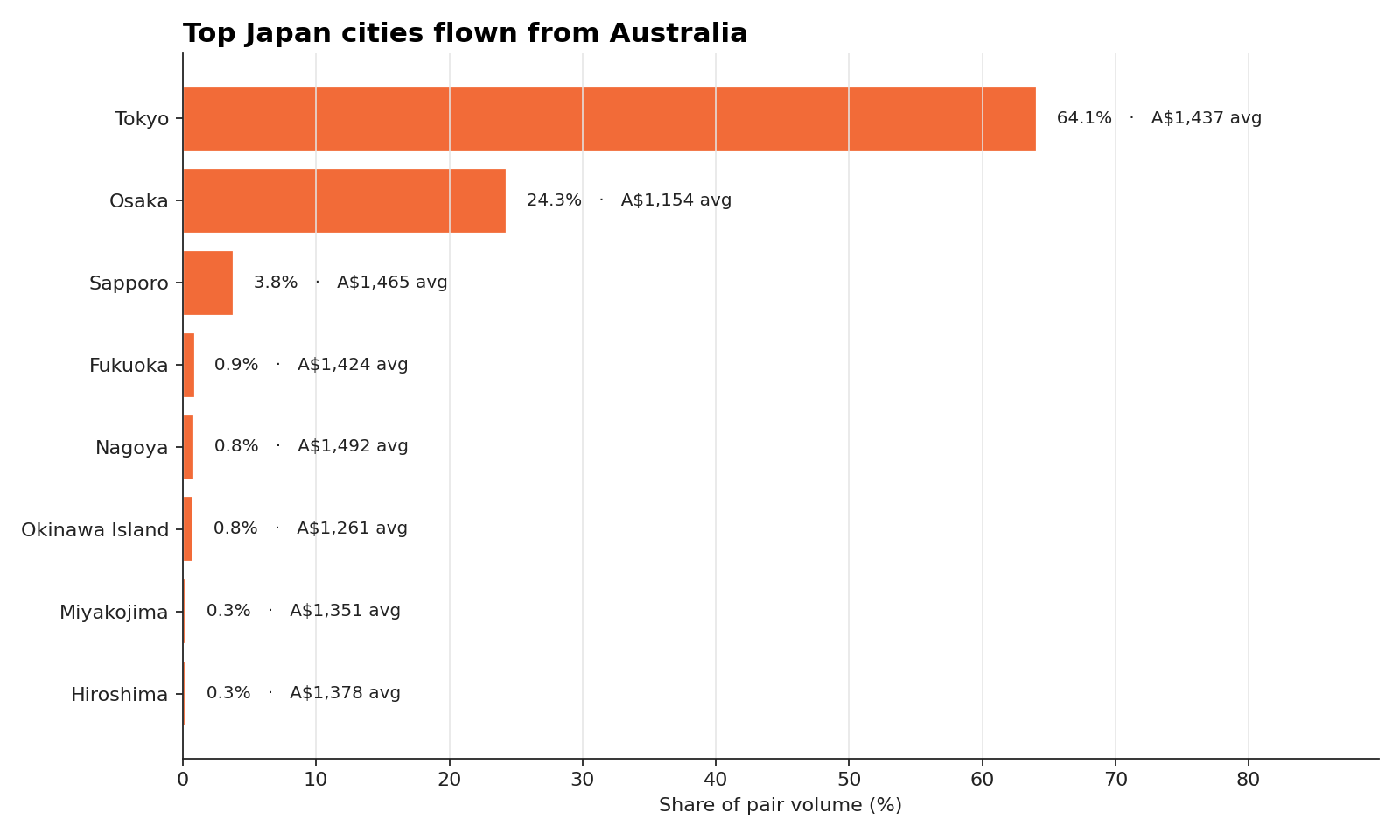
Top destination cities within Japan for flights from Australia to Japan. Fares show both the average and the typical (median) roundtrip; share figures are each city's percentage of the country's search volume.
The Tokyo airport divide
Tokyo dominates the Australian outbound market to Japan, capturing over 64% of all passenger volume. However, treating the capital as a single destination obscures a critical pricing split between its two main gateways: Haneda (HND) and Narita (NRT). Haneda, located closer to central Tokyo, functions as the high-cost hub, pushing Tokyo's overall average fare to A$1,437. Yet, our search data reveals a highly achievable A$1,095 median price. This gap of more than A$340 between the average and the median shows that the high headline prices are heavily skewed by business-class bookings and last-minute business travel, leaving plenty of room for leisure travelers to find competitive fares.
The key to unlocking these lower fares lies in how different Australian hubs route their traffic. In Sydney, where corporate demand is highest, 46.2% of travelers fly into Haneda, while only 19.5% land at Narita. Conversely, Melbourne and Brisbane route the largest share of their Tokyo traffic—44.7% and 46.4% respectively—directly into Narita. One likely explanation for this structural split is that low-cost carriers and budget-conscious partners concentrate their capacity at Narita to avoid Haneda's higher landing fees.
What this means for your trip is that you should not search for "Tokyo flights" as a single entity. If you are flying from Melbourne to Tokyo or Brisbane to Tokyo, compare Narita fares with Haneda fares before you book. Furthermore, do not assume that booking as early as possible guarantees the lowest price; our data suggests that airlines manage this dual-airport capacity dynamically, creating a strict booking window exactly 180 days out. If you are booking outside this sweet spot, you are highly likely to be funneled into the high-cost Haneda pricing tier.
Which Australian airport saves the most
While East Coast travelers routinely face a steep markup to reach Japan—with Brisbane and Sydney averaging A$1,397 and A$1,345 respectively—secondary gateways structurally bypass these high prices. Cairns leads this discount trend with an average fare of A$994, closely followed by Perth at A$1,046, proving that geographical proximity and low-cost carrier presence can slice hundreds of dollars off the national baseline. For travelers, this means the "Australian markup" is actually a regional tax; if you live in Western Australia or Queensland, you do not need to budget for a standard long-haul fare. Our recommendation is to avoid routing through Sydney or Brisbane if you can access these secondary hubs directly, as the local domestic connection to Cairns or Perth often costs far less than the East Coast long-haul markup. However, do not assume this discount applies to all secondary cities—Adelaide remains a major exception, averaging a steep A$1,745 due to its limited direct capacity.
Three routes that defy the long-haul tax
- Melbourne to Tokyo Haneda stands as the premier high-volume exception to the long-haul markup, where intense carrier competition drives fares down 34.4% below the baseline to a highly achievable A$804 median (n=151901 searches).
- Western Australian travelers can bypass the usual hub markups by targeting Fukuoka from Perth, a route that undercuts the national average by 33.6% to land at a median of A$826 (n=2411 searches).
- Even smaller regional origins show dramatic pricing relief if you watch for the right window, with Hobart to Tokyo Haneda flights dropping 27.3% below the expected baseline to A$1,132 (n=2038 searches).
Frequently asked questions
What is the cheapest month to fly from Australia to Japan?
June is the cheapest month to fly, with prices dropping 34.5% below the annual average. Conversely, December is the most expensive peak, running 73.1% above the average due to ski season and holiday demand.
When is the absolute best window to book my flights?
The data shows a strict booking window exactly 180 days out, where median fares drop to their lowest point of A$855. Do not wait until the last minute hoping for a drop, as fares spike to a median of A$1,192 inside of a week from departure.
Why do some sources show cheap flights 240 days out when your data says it is expensive?
At 240 days out, the median fare sits at a high A$1,362 because airlines initially release inventory at standard baseline rates. Fares only begin to drop as carriers gauge actual demand, meaning booking too early is just as costly as booking too late.
Which Japanese airport is the cheapest to fly into?
Osaka (KIX) is the most economical gateway, with a median price of A$892, compared to Tokyo’s median of A$1,095. If your itinerary allows, landing in Osaka and taking the bullet train to Tokyo is often cheaper than flying direct to the capital.
Which Australian city offers the cheapest flights to Japan?
Cairns (CNS) is the cheapest departure point with an average fare of A$994, closely followed by Perth (PER) at A$1,046. If you are flying out of Adelaide (ADL), expect a steep markup, where average fares jump to A$1,745 due to lower carrier competition.
Do Australian passport holders need a visa to enter Japan?
No, Australian citizens do not need to apply for a visa beforehand. Because Australia holds a strong passport ranking 7th globally on the Henley Passport Index, you can enter Japan visa-free for tourism purposes for up to 90 days.
When and Where to Book a Cheap Flight to Japan
Four choices usually lower what you pay to fly from Australia to Japan.
- Travel in May or June — fares are at their lowest in those two months and at their highest in December.
- Book about 180 days out — the median fare falls to A$855 at that point, compared with A$1,362 at 240 days.
- Look at Osaka — its median fare of A$892 is lower than Tokyo’s A$1,095.
- Leave on a Sunday — Sunday departures have a median of A$921, while Friday departures have a median of A$1,066.
The cheapest Japan fares appear in a short window about six months before departure. RatePunk keeps track of what flights from your home airport usually cost, and we alert you when one drops below that price.
Methodology
This analysis is built on anonymized economy-class fare searches from RatePunk's flight-price dataset. The analysis draws from a broader global sample of 40,688,214 searches across 22,792 routes. The search records for this Australia-to-Japan corridor were captured between August 5, 2025, and May 7, 2026, covering scheduled departure dates stretching from August 5, 2025, through April 30, 2027.
All prices are calculated and shown in Australian Dollars (AUD). To keep the comparisons clear, our destination and city tables report both the average and the typical (median) fare, while all booking-lead-time and weekday figures are medians. The seasonality charts use an index where 100 represents the baseline annual average, making it easier to spot when prices swing away from the norm.
Published: May 29, 2026
Updated: October 15, 2026