
Flights from Australia to New Zealand in 2027: How to Pay Less
Booking flights from Australia to New Zealand? Learn which months cost the least, how early to book, and how fares vary by arrival and departure city.

By Heather Budreviciene
Published: May 29, 2026 • 9 min read
Updated: October 15, 2026

The Trans-Tasman Pricing Paradox
While New Zealand is Australia's most accessible international destination, the trans-Tasman corridor operates as a premium-priced commuter and leisure trunk line rather than a budget pressure valve, with baseline fares rarely dipping below a steep A$600 median. Trans-Tasman flights are structurally expensive because New Zealand operates more like a high-cost domestic route than a cheap holiday run. Despite the short distance, our analysis of over 2.4 million outbound searches reveals a median fare of A$779 for a round trip.
This pricing pressure stems from a heavy concentration of demand. Auckland alone commands more than 37% of the traffic. Without aggressive budget-carrier competition to act as a price-damping force, airlines can keep fares high. Travelers often treat the three-hour hop to Auckland or Queenstown as a casual, last-minute decision. However, the data shows that securing a reasonable fare across the Tasman requires the same long-lead booking discipline you would use for a long-haul flight to Asia. If you do not lock in your seats early, you will pay a steep price penalty for proximity.
When prices are cheapest
Trans-Tasman flight pricing behaves less like an international holiday run and more like a tightly controlled domestic route. The seasonality curve reveals two sharp demand spikes that align perfectly with Australian school holidays rather than gradual weather shifts. September prices surge to an index of 127.0, but the absolute peak arrives in December at 145.4, driven by the concentrated pressure of Christmas travel and summer breaks. Because New Zealand lacks the deep budget-carrier competition found on Asian routes, airlines face little pressure to discount during these high-yield family travel windows.
For your trip planning, this means treating a quick hop to Auckland with strict booking discipline. If you fly during school holiday windows, you will pay a steep price markup regardless of how early you book.
To avoid these markups, target the shoulder months. May represents the deepest trough in our data, offering a 79.0 price index, nearly half the cost of a December ticket. If you must travel in spring, shifting your departure just into late October or November bypasses the September school-holiday inflation while still capturing mild weather.

Monthly price index for flights from Australia to New Zealand. Index = 100 is the annual average. Peak: December (145). Trough: May (79).
How early to book
To secure the best value on trans-Tasman flights, Australian travelers must abandon the spontaneity usually associated with short-haul weekenders. Our flight-search data reveals that the absolute sweet spot for booking flights to New Zealand is 90 days out, where the median fare bottoms out at A$261.
Waiting until the final month triggers a steep pricing penalty. The median fare climbs to A$358 at 30 days and reaches A$434 in the final three days before departure. This steady escalation reflects a market dominated by corporate travel and visiting-friends-and-family (VFR) demand. This sector lacks the budget-carrier competition that usually depresses close-in pricing on European or Southeast Asian holiday runs.
The price of these tickets is highly unresponsive to demand shifts close to departure. This price rigidity, meaning fares do not budge even when planes are empty, is typical of routes with few low-cost competitors. While our data shows a massive spike to A$584 at the 240-day mark, this is a common statistical artifact of airlines loading high-yield baseline fares nearly a year in advance; do not panic-book that early. Secure your seats between 60 and 120 days before departure. Within this best window, the departure day itself offers only modest price variation, meaning your primary leverage is how many months ahead you lock in the ticket, not which day of the week you fly.
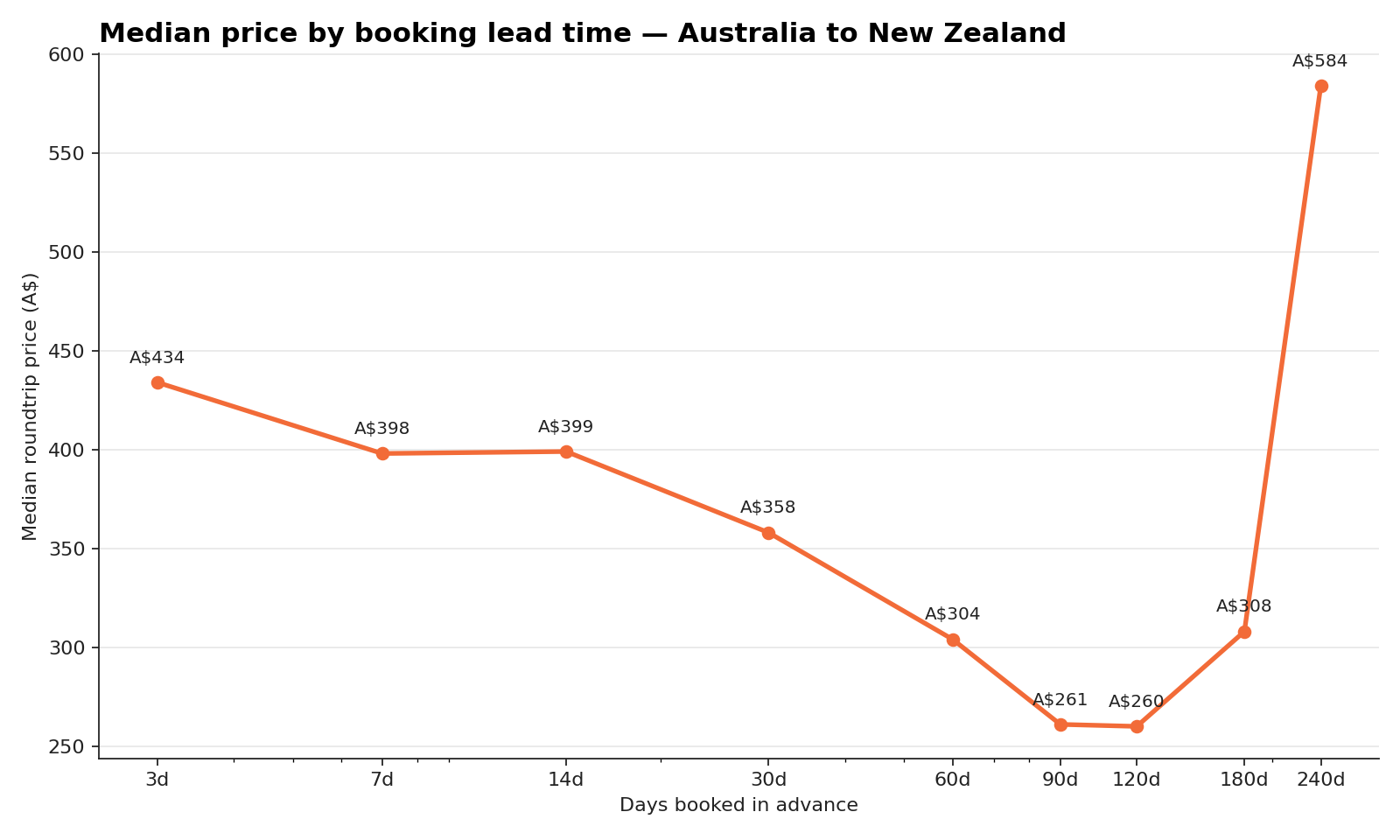
Median roundtrip fare by booking-window length (days before departure) for flights from Australia to New Zealand. Based on 5,732 search snapshots.
Where in New Zealand to fly
The trans-Tasman aviation market is highly consolidated, mirroring the pricing dynamics of a domestic trunk route. Our search data reveals that Auckland alone absorbs nearly 38% of all Australian demand to New Zealand, functioning as the primary traffic hub for the route. Because traffic concentrates so heavily into this single northern hub, regional entry points like Christchurch and Dunedin enjoy little competitive pressure to drop fares. With average ticket prices across the entire market sitting at A$779, travelers cannot rely on last-minute budget capacity to bail them out. Navigating this market requires the same advanced booking discipline you would normally reserve for a long-haul flight.
| Rank | City | Avg roundtrip | Share of pair |
|---|---|---|---|
| 1 | Auckland | A$762 | 37.6% |
| 2 | Queenstown | A$740 | 22.1% |
| 3 | Christchurch | A$801 | 19.9% |
| 4 | Wellington | A$756 | 10.3% |
| 5 | Dunedin | A$768 | 2.1% |
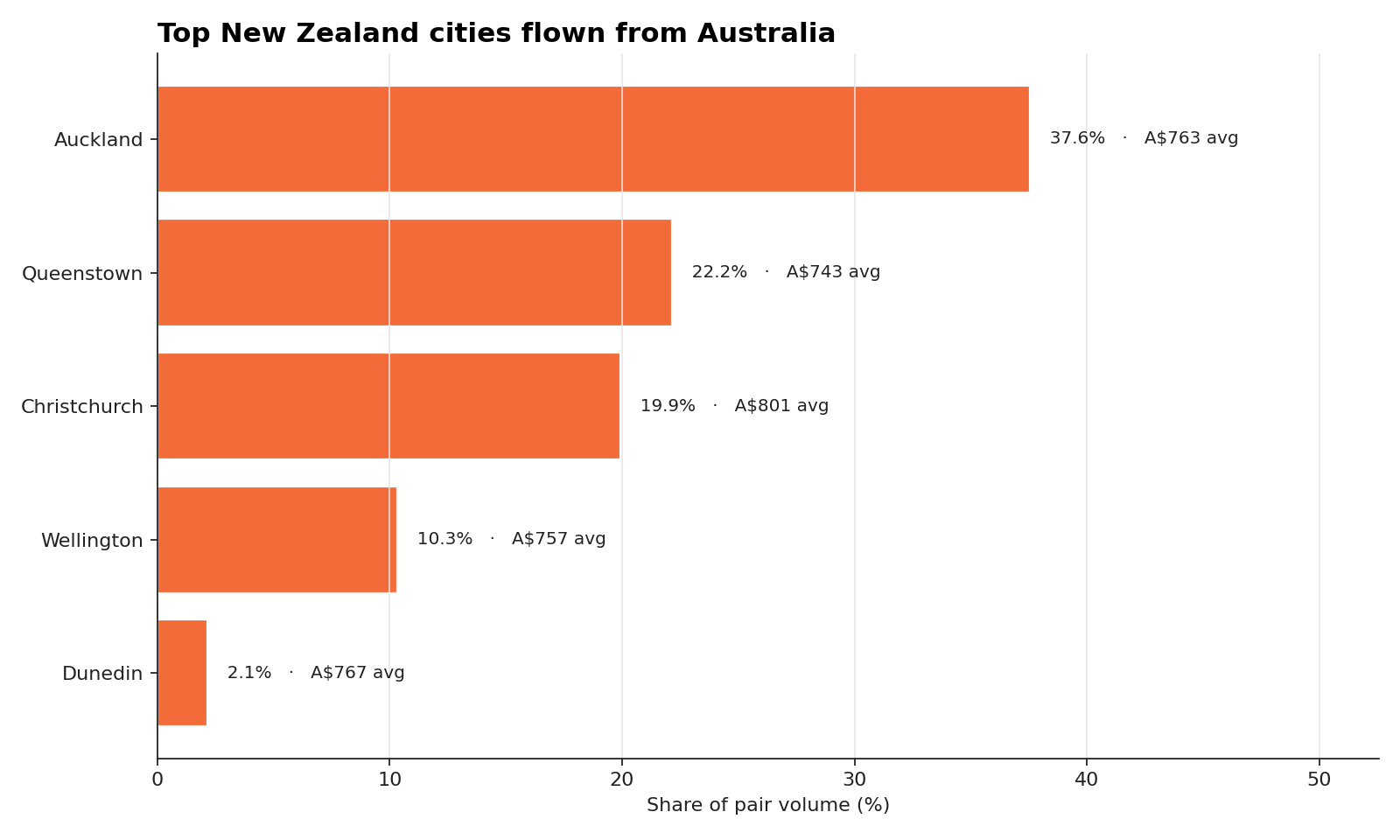
Top destination cities within New Zealand for flights from Australia to New Zealand. Fares show both the average and the typical (median) roundtrip; share figures are each city's percentage of the country's search volume.
The Auckland Bottleneck
Auckland functions as the central traffic hub of trans-Tasman aviation, absorbing 37.6% of all flight volume from Australia in our dataset. With over 910,000 searches directed at Auckland Airport alone, this single gateway dictates the pricing rhythm for the entire market. Because the route behaves more like a high-cost domestic route than a highly competitive holiday run, the average fare to Auckland sits at a high A$762. Unlike Southeast Asian routes where budget carriers regularly suppress prices, the trans-Tasman corridor lacks the low-cost options needed to force legacy carriers into deep discounting.
This high concentration of demand means you cannot approach booking a trip to Auckland with the casual, last-minute attitude of a domestic weekend getaway. The data indicates that waiting for a promotional fare drop on this route is generally a losing strategy. Instead, the high volume and stable demand create a pricing environment where fares climb steadily as departure approaches. One likely explanation is the heavy mix of corporate travel and expat families visiting relatives, two segments where airlines can expect buyers to pay a higher price for specific dates regardless of cost.
To avoid this hub premium, we recommend booking trans-Tasman flights with the same 60-to-120-day lead discipline you would apply to a long-haul journey to Europe or North America. If your final destination is elsewhere in the country, do not assume routing through Auckland is your only viable path; check direct flights to Christchurch or Wellington, which average A$801 and A$756 respectively. While Christchurch carries a slight markup, bypassing the Auckland hub can occasionally yield better seat availability and more stable pricing windows during peak holiday periods.
The East Coast discount vs. the Perth premium
Geography dictates a stark east-west divide across the Tasman, with fares scaling sharply for long-distance departures. While east-coast travelers enjoy relatively competitive access, with Gold Coast averaging A$594, Sydney at A$652, and Brisbane at A$695, West Australians face a massive geographic penalty, with Perth fares averaging A$1,246 for a trip heavily concentrated on Auckland.
For travelers, this means New Zealand cannot be treated as a last-minute weekend run if you live outside the eastern seaboard. Because low-cost carriers do not provide a structural price-damping option on these routes, pricing behaves with the rigidity of a long-haul corridor. If you are flying from Western Australia or the territories, we recommend booking with the strict three-to-four-month lead discipline usually reserved for flights to Europe, rather than waiting for seasonal sales that rarely materialize.
Four bookings most travelers miss
- Sunshine Coast to Hamilton bypasses the high-cost Auckland hub pricing entirely, offering a 35.5% discount against the baseline fare for travelers willing to fly secondary routes (n=916 searches).
- Perth to Hamilton provides a rare alternative route for West Australian travelers, cutting 29.5% off the standard trans-Tasman baseline on this highly consolidated corridor (n=2,655 searches).
- Hobart to Rotorua avoids the main-trunk monopoly pricing, delivering a 29.0% saving by flying into the North Island's adventure hub (n=775 searches).
- Sunshine Coast to Wellington reveals that capital-city access does not have to carry a markup, running 28.7% cheaper than the expected regional baseline (n=783 searches).
Frequently asked questions
What is the cheapest month to fly from Australia to New Zealand?
Our analysis of trans-Tasman search data shows that May is the cheapest month to fly, with prices dropping to 79.0% of the yearly average. Conversely, December is the most expensive peak at 145.4% of the index, meaning you will pay nearly double if you travel during the Christmas holidays.
How far in advance should I book my flights to New Zealand?
The best booking window is 90 to 120 days before departure, where median fares sit at their lowest point of A$261. Booking earlier than 180 days out actually costs more (A$308 median), while waiting until the final month causes prices to climb as cheaper seat inventory disappears.
Which New Zealand airport is the cheapest to fly into?
Queenstown (ZQN) is the cheapest arrival point with an average fare of A$740, closely followed by Wellington (WLG) at A$756 and Auckland (AKL) at A$762. Christchurch (CHC) is the most expensive major gateway, averaging A$801, which is A$39 more than Auckland.
Are last-minute flights to New Zealand cheaper?
No. The median fare rises from A$261 at 90 days out to A$358 at 30 days and A$398 at 7 days out, and the choice of flight times and routes shrinks close to departure, so we do not recommend waiting.
Do Australian citizens need a visa to enter New Zealand?
No, Australian passport holders do not need to apply for a visa to enter New Zealand and can typically gain residency status on arrival. This ease of access contributes to the massive trans-Tasman market, which saw over 2.4 million searches in our dataset.
How to Pay Less for a Flight to New Zealand
Three decisions usually lower the price of a trans-Tasman ticket.
- Skip December — it is the priciest month at an index of 145.4, while May is the cheapest at 79.0.
- Book 60 to 120 days ahead — the median fare is lowest at 90 days out and climbs to A$434 in the final three days.
- Compare arrival cities — Queenstown averages A$740 and Wellington A$756, while Christchurch averages A$801.
Trans-Tasman fares are at their lowest about three months before departure. RatePunk keeps track of what flights from your home airport usually cost, and we alert you when one drops below that price.
See Flight Deals from Your Home Airport
Methodology
This analysis of the trans-Tasman market is built on our flight-price dataset, which combines economy-class fare searches to uncover structural pricing trends. For this study, we analyzed a sample size of 40,688,214 searches across 22,792 distinct routes. These anonymized flight-search records were captured between August 5, 2025, and May 7, 2026, covering scheduled departures stretching from August 5, 2025, all the way through to April 30, 2027.
To keep comparisons consistent for Australian travelers, all pricing and fare trends cited throughout this piece are calculated and presented in Australian Dollars (A$). By tracking this volume of forward-looking demand, we are able to isolate the genuine pricing floors from temporary fare fluctuations.
Published: May 29, 2026
Updated: October 15, 2026