
Cheap Flights from Australia to United States: A Data-Driven Guide (2026)
Planning a US trip? Discover why West Coast hubs like Los Angeles average A$1,927 while inland destinations carry steep premiums. Learn when to book.
By RatePunk Research · Updated 2026-05-27
The Transpacific Reality Check
Crossing the Pacific is the most expensive flight decision Australian travellers regularly make. This route carries a steep geographic price penalty. Travellers must choose between high-volume West Coast gateways or trading travel time for double-digit savings. Across more than 40 million searches in our dataset, the average return fare from Australia to the United States sits at A$2,224. This is not a cheap corridor. The pricing is highly distorted by where you land.
Nearly 30% of all transpacific traffic squeezes through Los Angeles, where average fares sit at A$1,927. If you head further east to hubs like New York or Chicago, that baseline cost jumps by roughly A$700.
For long-haul planners, the strategy is clear. You can accept the geographic price penalty of a direct flight to the West Coast, or you can bypass it by routing through secondary regional connection points. Our data shows that understanding this pricing structure is the only reliable way to keep transpacific costs from blowing out your entire travel budget.
The December Peak and the March Window
The transpacific flight corridor is highly sensitive to the Australian school holiday calendar, creating a dramatic pricing swing of over 60% between the cheapest and most expensive times to fly.
Our search data reveals a massive pricing spike in December, where the monthly index climbs to 143.3. This surge is driven by the collision of statutory summer leave and the long school break, which sends families rushing to the US West Coast. If you fly during this window, you are paying the ultimate price markup for transpacific capacity.
Conversely, the market experiences a sharp correction in the first quarter of the year. March emerges as the absolute cheapest month to fly, with prices dropping to an index of 82.6—nearly half the cost of a December departure.
For travellers, this sharp drop-off means that delaying a US trip by just eight to twelve weeks yields massive dividend savings. If your dates are flexible, avoid the December-to-January crush entirely. Planning your departure for March or even February bypasses the peak school-holiday price markup, allowing you to allocate those saved hundreds toward high accommodation costs on the ground in the US.

Monthly price index for flights from Australia to United States. Index = 100 is the annual average. Peak: December (143). Trough: March (83).
The 120-Day Sweet Spot
The common belief that you must book transpacific flights a year in advance to secure the lowest fare is a costly misconception. According to Ratepunk’s analysis of flight-search records, the absolute sweet spot for booking flights from Australia to the United States is 120 days out, where the median fare drops to a curve-low of A$1,612.
Locking in your trip 240 days in advance actually incurs a steep cost penalty, with median prices sitting at A$2,070—nearly A$460 more than the four-month mark. This pricing pattern suggests that airlines initially price transpacific inventory high to capture inflexible corporate and early-planning leisure travellers, only softening fares when actual demand signals emerge closer to departure.
While our data shows a slight secondary dip to A$1,725 at the 14-day mark, we strongly advise against waiting. This late drop is a statistical trap; airlines are merely clearing remaining middle seats on less-desirable routings. Waiting this long means your choice of carriers, departure times, and direct routings collapses entirely.
To maximize savings within this four-month window, pair your timing with a midweek departure. The price spread between departure days is modest but real, with Wednesday flights offering the most competitive median rate of A$1,767, whereas flying on a Tuesday pushes fares back up. Aim to monitor fares closely around the 150-day mark, and prepare to book when the window hits 120 days.
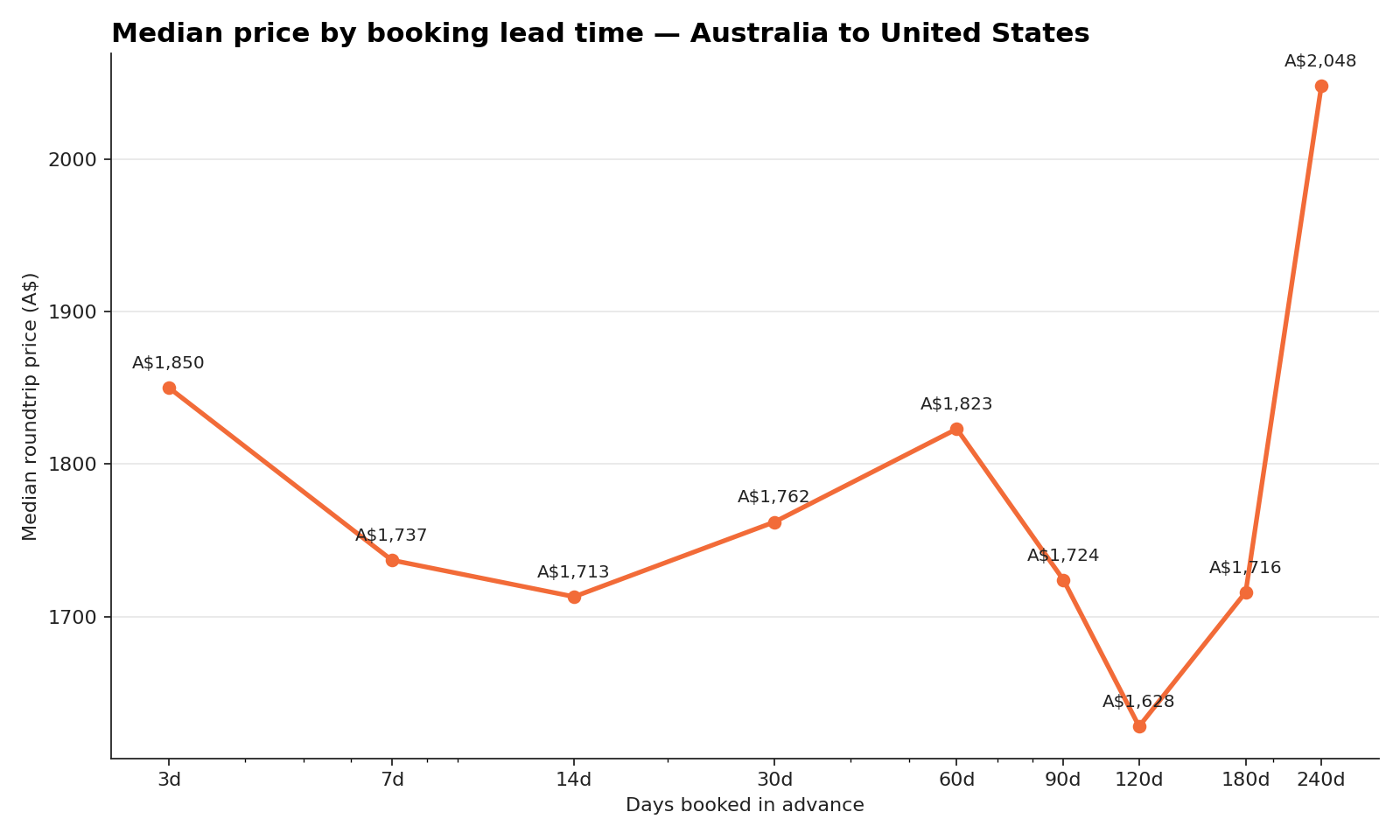
Median roundtrip fare by booking-window length (days before departure) for flights from Australia to United States. Based on 2,398,172 search snapshots.
Where Australians Land in the United States
Australian transpacific travel is heavily concentrated, with nearly 41% of all US-bound traffic squeezing through just two West Coast gateways: Los Angeles and San Francisco. This extreme geographical concentration creates a steep pricing gradient the moment you try to push further east. While airlines price these coastal entry points competitively to capture the bulk of demand, continuing onward to inland hubs like Dallas or East Coast destinations like New York adds a massive price markup, often pushing average return fares well past A$2,400. For travellers, the strategic choice is stark: pay the coastal toll and book separate domestic connections, or accept longer, multi-stop itineraries to bypass the West Coast price markup.
| Rank | City | Avg roundtrip | Share of pair |
|---|---|---|---|
| 1 | Los Angeles | A$1,927 | 29.4% |
| 2 | New York | A$2,624 | 15.1% |
| 3 | Honolulu | A$1,840 | 12.0% |
| 4 | San Francisco | A$1,799 | 11.6% |
| 5 | Dallas | A$2,399 | 5.0% |
| 6 | Washington, D.C. | A$2,496 | 2.3% |
| 7 | Chicago | A$2,600 | 2.0% |
| 8 | Seattle | A$2,578 | 1.9% |
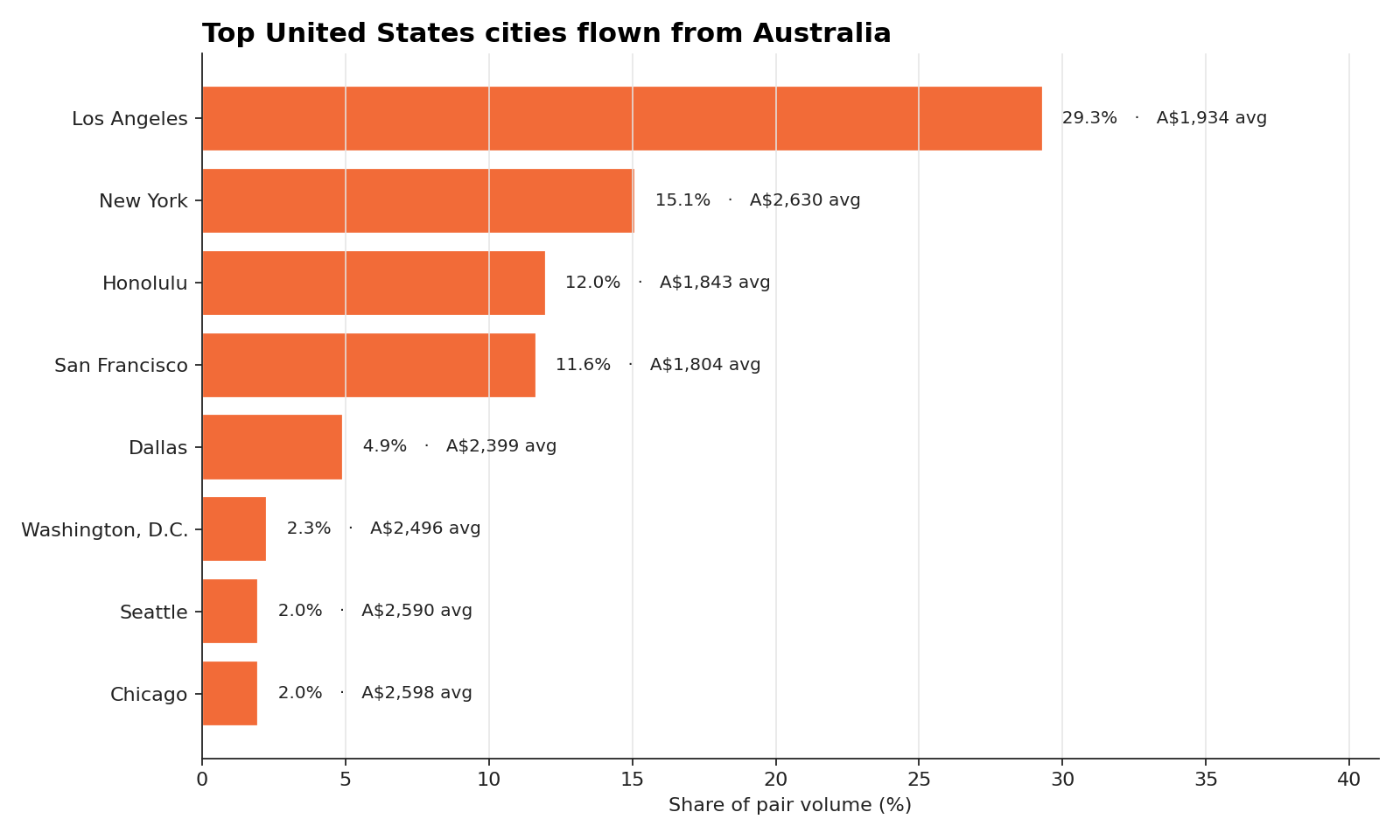
Top destination cities within United States for flights from Australia to United States. Fares show both the average and the typical (median) roundtrip; share figures are each city's percentage of the country's search volume.
The Los Angeles Bottleneck
Los Angeles is the undisputed heavyweight of the transpacific market, capturing nearly 30% of all Australian travel to the United States with over 835,000 searches in our dataset. This massive concentration of volume makes it the primary anchor for transpacific pricing dynamics, yielding an average return fare of A$1,927. While San Francisco actually edges it out on raw affordability at A$1,799, Los Angeles remains the high-frequency corridor where airline competition is fiercest. This volume acts as a pricing buffer; even with high demand, the sheer capacity on the Sydney to Los Angeles and Melbourne to Los Angeles routes keeps fares from spiking as wildly as they do on secondary routes.
For travellers, this means Los Angeles should be treated as your default entry point, even if your final destination is on the East Coast. The average fare to New York sits at a steep A$2,624, while Chicago jumps to A$2,600. One likely explanation for this A$700 gap is the lack of direct, high-capacity competition to eastern hubs, which allows carriers to charge a steep premium for single-ticket journeys.
We recommend booking your transpacific flight directly into Los Angeles, and then purchasing a separate domestic US flight to your final destination. Splitting the ticket (or choosing to separate your transpacific flight from domestic US legs) frequently saves A$300 to A$400 per person, even after accounting for US domestic baggage fees. However, do not attempt this self-transfer with less than a four-hour layover. Clearing US customs at LAX is notoriously slow. Because your flights are on separate tickets, the domestic carrier is under no obligation to rebook you for free if you miss your connection.
How Your Departure City Dictates the Fare
Sydney and Melbourne dominate transpacific travel, accounting for over 53% of all US-bound flight searches from Australia, but East Coast travellers enjoy a pricing advantage that leaves Western Australia heavily penalised. While Sydney and Melbourne keep median fares relatively anchored around A$2,040 to A$2,089 due to intense airline competition on direct routes to Los Angeles, Perth travellers face a steep isolation tax, with median fares climbing to A$2,322.
What this means for your trip planning is that geography dictates your routing strategy. If you are flying from the East Coast, there is no financial reason to route through another domestic hub. Stick to direct flights out of Sydney, Brisbane, or Melbourne to keep costs down. However, if you are based in Perth, do not assume a single ticket is your only option. It is often worth pricing a separate domestic connection to Melbourne or Sydney first, as the combined cost of a domestic leg and an East Coast transpacific ticket can frequently undercut the direct Perth-to-US price penalty.
Three Bookings Most Travellers Miss
- Perth travellers heading to the Rocky Mountains can bypass the steep West Coast gateway price penalty via Denver, where fares run a massive 39.8% below the baseline average of A$3,077 (n=508 searches).
- Cairns offers a highly unusual East Coast alternative route to Miami, with median fares sitting 30.6% cheaper than the typical regional baseline of A$2,633 (n=2,034 searches).
- Townsville presents a striking structural anomaly for East Coast travellers, with flights to New York averaging just A$1,487—a 26.7% discount that makes it one of the cheapest entry points to the US East Coast (n=1,264 searches).
Frequently Asked Questions
What is the cheapest month to fly from Australia to the United States?
March is the cheapest month to fly, with prices sitting at 82.6% of the yearly average. Conversely, December is the most expensive time to travel, peaking at an index of 143.3% due to holiday demand.
How much extra does it cost to fly during the peak summer season?
The price swing between the cheapest and most expensive months is 60.7%. This means a ticket booked for a December departure will typically cost over 73% more than the exact same route flown in March.
Which US entry point offers the cheapest average airfare?
San Francisco (SFO) is the most budget-friendly gateway, with an average fare of A$1,799, closely followed by Honolulu (HNL) at A$1,840. Flying into Los Angeles (LAX) is also highly competitive at A$1,927, while capturing nearly 30% of all transpacific traffic from Australia.
How much more will I pay if I fly into the US East Coast or Midwest?
Choosing New York (EWR) or Chicago (ORD) adds a massive price penalty, with average fares climbing to A$2,624 and A$2,600 respectively. If you are heading east, we recommend booking a cheaper ticket to San Francisco or Los Angeles and buying a separate domestic connection to save hundreds of dollars.
How many days before departure should I book my flights?
The absolute sweet spot in our search data is 120 days out, where the median price drops to A$1,612. Booking further out at 240 days actually costs more (A$2,070), while waiting until the final month before departure causes prices to climb back toward the A$1,750 mark.
Do Australian citizens need a visa to enter the United States?
No, Australians do not need a traditional visa for short tourist stays, as Australia holds a strong Henley passport rank of 7 with 182 visa-free destinations. Instead, you must apply online for an ESTA (Electronic System for Travel Authorization) before heading to the airport.
Transpacific fares swing wildly, but booking around 120 days out helps bypass the steep West Coast geographic price penalty. RatePunk’s price-tracker monitors these volatile US routes and alerts you the moment the sweet spot opens for your dates. Install the RatePunk extension to let the data find your window.
Methodology
This analysis is based on aggregated economy-class fare searches from Ratepunk's flight-price dataset, capturing 40,688,214 searches across 22,792 routes. The search records were collected between 5 August 2025 and 7 May 2026 for departures scheduled from 5 August 2025 through to 30 April 2027.
All prices are cited in Australian Dollars (AUD). To ensure the findings remain relevant to typical consumer experiences, the dataset excludes extreme outliers and focuses on return itineraries originating in Australia.
May 29, 2026