
Flying With a Cold, the Flu, or an Ear Infection: What to Know Before Your Flight
Can you fly with a cold, the flu, or an ear infection? What TSA and airlines allow, what you're owed, and what it costs to move your trip.

By Heather Budreviciene
Published: November 4, 2026 • 10 min read
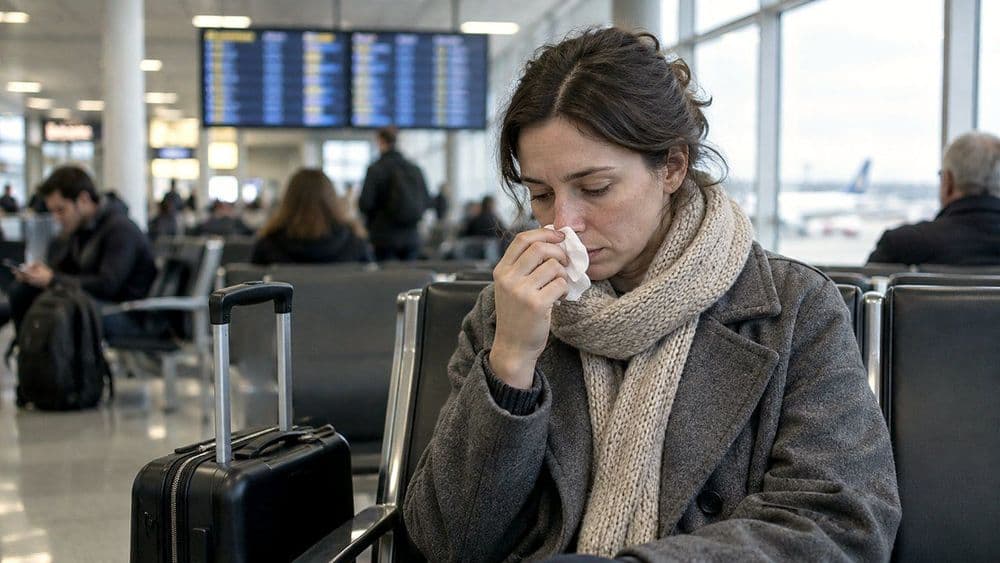
Can you fly with a cold? That's a call for you and your doctor, but knowing the rules ahead of time can make deciding what to do easier.
If you're feeling rough with a trip coming up and aren't sure whether to fly, change your dates, or cancel, you're not alone.
This guide will walk you through the rules around which medicines you can bring through security, what airlines let you change, what you're owed if you can't fly, and what it can cost to move your trip.
Can You Fly With a Cold?
Yes, but be aware that a cold can cause some discomfort when flying. Mayo Clinic lists a common cold, a sinus infection, and hay fever as common risk factors for airplane ear. Airplane ear is the pressure you feel when the plane climbs after takeoff or comes down to land.
Mayo Clinic says airplane ear usually isn't serious and gets better with simple self-care. Here are two recommendations that can help on the plane (Johns Hopkins Medicine):
- Swallowing often
- Chewing gum, especially during takeoff and landing
If you're not sure whether to fly, or what to take for your cold, check with your doctor.
Can You Fly With the Flu or a Fever?
If you have the flu, the CDC says not to travel. Its advice for anyone with flu-like symptoms is to stay home and away from others.
Whether it's the flu or a fever, travelers are advised to wait until both of these conditions have been met for at least 24 hours:
- Your symptoms are getting better overall
- You haven't had a fever, without using fever-reducing medicine
If you're not sure whether you're well enough to fly, ask your doctor.
Can You Fly With an Ear Infection?
Flying with an ear infection can be very uncomfortable, so waiting a few days is often worth it. Middle ear infections increase the risk for experiencing airplane ear (Mayo Clinic), the pressure and pain you can feel as the plane goes up or down.
But ear infections usually don't last long. The NHS says most clear up within 3 days, although symptoms can sometimes last up to a week. Moving your flight by a few days can make a trip more comfortable.
Ask your doctor before you fly with an ear infection.
What Medicine Can You Bring on a Plane?
TSA allows any amount of pills and solid medicine as long as they go through screening, though some states require prescriptions to stay in the labeled pharmacy bottle. Liquid medicine is allowed in reasonable amounts if you tell the officer, and medical masks are allowed. Other liquids and sprays must be 3.4 ounces (100 milliliters) or less, in one quart-sized bag.
Most cold and flu medicine can come with you in your carry-on bag. Here is what TSA allows:
- Pills and other solid medicine, in carry-on and checked bags. They still go through screening
- Liquid medicine in reasonable amounts, even above the usual liquids limit. Tell the TSA officer and put it in a separate bin
- Other liquids, such as a nasal spray you don't declare as medicine, in containers of 3.4 ounces (100 milliliters) or less, in one quart-sized bag
- Medical masks, in carry-on and checked bags
TSA doesn't specifically mention nasal spray or cough drops, so the general rules apply. TSA officers have the final say on what goes through the checkpoint.
Can You Change Your Flight If You're Sick?
Most airlines let you change a standard fare without a change fee, but you pay the difference if the new flight costs more. Basic fares are the exception. Many basic fares can't be changed at all, and others cost a fee.
| Airline | Standard fares | Basic fares |
|---|---|---|
| Delta | No change fee; you pay any fare difference | Only if the ticket is changeable |
| United | No change fee on most flights | Not listed |
| American | A fare difference may apply | Can't be changed after 24 hours |
| Alaska and Hawaiian | No change fee; a fare difference may apply | Can't be changed |
| Southwest | No change fee; you pay any fare difference | Can't be changed unless you upgrade |
| JetBlue | No change fee; you pay any fare difference | $150 plus the fare difference |
| Frontier | No change fee on bundles | $149 within 59 days of departure |
| Breeze | Fare difference only | Same as standard |
| Air Canada | Fare difference applies | Depends on the fare |
| Lufthansa | Fare difference only | $199 plus the fare difference |
| Emirates | Fee depends on the fare | Fee depends on the fare |
| Aer Lingus | Fare difference plus a fee by fare | Fee depends on the fare |
| British Airways | Depends on your ticket's rules | Depends on your ticket's rules |
| Virgin Atlantic | Fee depends on the fare | Fee depends on the fare |
A few rules matter most when you're sick:
- Cancel before your flight leaves. If you just don't show up, you can lose the credit
- Check your fare type. Basic fares can cost more to change, or can't be changed at all
- International airlines also set change fees by fare type
- If you get sick partway through a trip, some airlines may extend your ticket with a medical certificate
Look at your airline's own page to see their full policy.
Can You Get a Refund If You're Sick?
Most tickets aren't refundable just because you're sick. The U.S. Department of Transportation says that if you buy a non-refundable ticket and decide not to fly, you aren't owed a refund when the flight takes off without you.
Federal rules make two exceptions:
- If an airline refuses to fly you because of a contagious illness, it must let you travel within 90 days at your original fare with no penalty, or refund the unused flights
- If a doctor says you shouldn't fly because you have a serious contagious disease, the airline owes you a travel credit that lasts at least five years.
It's worth noting that the travel credit rule doesn't cover the common cold, and it doesn't name the flu specifically. The rule applies to U.S. airlines and to foreign airlines on flights to, from, or within the U.S.
If, by chance, the airline cancels your flight, the Department of Transportation says you have the right to a refund if you choose not to travel.
Here's more on what airlines owe you when a flight is canceled.
What Does It Cost to Push Your Trip Back?
If you're sick and need to move a trip, what it costs depends on your ticket. Most airlines don't charge a change fee on standard fares, so you pay only the fare difference.
If you have a non-refundable ticket, or your airline won't let you change your dates, you may have to buy a new ticket, and that's where timing matters. If your new flight leaves within a week, expect to pay more. In our flight data, a domestic round trip found in the last week before departure cost about $110 more than the same trip found three to five weeks ahead, and the last-week price was higher on most routes.
If your ticket can't be changed, check what your travel insurance covers before you buy a new one.
Does Travel Insurance Cover Being Sick?
Travel insurance can pay you back when you're too sick to travel, but only if a doctor says so and your policy covers it. Trip cancellation insurance covers the money you've put into your trip, such as flights, so check that your policy covers canceling if you or a close family member gets sick.
The National Association of Insurance Commissioners (NAIC), the group of state insurance regulators, lists a few things to know:
- Trip cancellation coverage can pay when a doctor says you're not well enough to travel
- Pre-existing health conditions are a common exclusion
- Cancel for Any Reason coverage pays back only part of the trip, 50% to 75% of the price, and usually has to be added soon after booking
- Policies usually cost 5% to 10% of the total trip price
Check what your credit card covers, too. Be sure to read your policy before you cancel.
How to Handle Getting Sick Before a Flight
Check your symptoms (wait until you've gone 24 hours without a fever and your symptoms are getting better), ask your doctor for a note if your airline or insurer may need one, and check your travel insurance and credit card coverage. Think about pushing your trip back to give yourself time to recover, since most airlines charge only the fare difference, and change or cancel before departure, because if you don't show up you can lose the credit.
If you get sick before a flight, these steps can help:
- Wait to fly until you've gone 24 hours without a fever and your symptoms are getting better
- Ask your doctor whether you're well enough to fly, and get a note if your airline or insurer might need one
- Push your trip back to give yourself time to recover. Most airlines charge only the fare difference
- Change or cancel before departure, so you keep any credit
- Check your travel insurance and credit card coverage before you cancel
Frequently Asked Questions
Can an airline refuse to let you fly if you're sick?
Yes, but only if a contagious illness poses a direct threat to others. If an airline refuses you, it must let you fly within 90 days at your original fare or refund the unused flights.
Should you wear a mask on the plane if you're sick?
If you're still sick, the CDC's advice is to stay home rather than travel. Once you're back to your normal routine, it suggests extra care for the next 5 days, including a well-fitted mask. TSA allows medical masks in both carry-on and checked bags, so you can bring them on the plane.
How long after an ear infection can you fly?
There's no set waiting time, so ask your doctor. The NHS says most ear infections clear up within 3 days, though symptoms can sometimes last up to a week. Waiting until your ear feels better usually makes a flight much more comfortable.
Can flying with a cold damage your ears?
Flying with a cold can cause airplane ear, the pressure or pain you feel as the plane climbs or lands. Mayo Clinic says airplane ear usually isn't serious and gets better with self-care. Swallowing often and chewing gum during takeoff and landing can help.
Can you bring cough drops and nasal spray on a plane?
Yes. TSA has no separate rule for cough drops or nasal spray. Pills and other solid medicine can go in carry-on and checked bags. Liquids like nasal spray go in your quart-sized bag in containers of 3.4 ounces or less, or you can declare larger amounts of liquid medicine at the checkpoint.
How We Got These Numbers
The fares come from domestic round-trip flight searches we tracked from U.S. airports between May and November 2026. We compared the typical price of the same trip found in the last week before departure with the price found three to five weeks ahead. These are prices shown in searches, not prices people paid.
The health guidance comes from the CDC, Mayo Clinic, Johns Hopkins Medicine, and the NHS. The travel rules come from TSA, the U.S. Department of Transportation, state insurance regulators, and each airline's own website. We checked all of them on November 3, 2026.
About RatePunk
Reading fares and understanding what makes them move is our area of expertise, and the prices in this article come from our own flight data. We run RatePunk Flights, a paid membership that watches prices out of the airport you fly from. When a route drops well below what it normally costs, the deal shows up in your app and on your dashboard, so you can book it wherever you like, with the airline itself or a travel site you already use.
If you found this interesting, you might also enjoy these articles:
November 4, 2026