Bumped From Your Flight? Here's What the Airline Owes You
Got bumped from a full flight? See when the airline legally owes you cash, when you get nothing, how volunteers can negotiate, and how to get paid.

By Heather Budreviciene
Published: November 19, 2026 • 10 min read
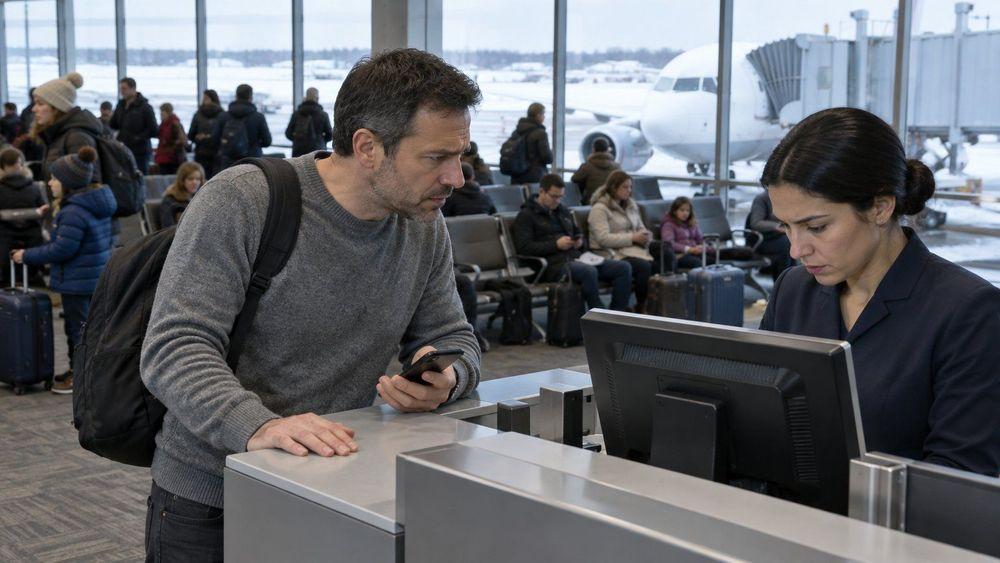
One storm or FAA hiccup, and a smooth trip home can turn into a crowded gate and an oversold flight. If that's where you're standing right now, we’ll walk you through exactly what the airline owes you.
Here's the good news: if an airline bumps you from an oversold flight against your will, they usually owe you cash under U.S. DOT rules.
And if your plans can bend a little, giving up your seat on purpose can earn you travel credit or even cash.
Let’s take a look at what you're owed, who qualifies, how volunteering works, who gets bumped first, and how to walk away with more money in your wallet.
Bumped Flight Compensation by Delay
Getting bumped against your will means the airline owes you money based on the price of your one-way ticket, and the later you get to your destination, the more you're owed.
(That "against your will" part is key. If you volunteer instead, you get whatever you and the airline agree on, not amounts described in this section.)
Here's how it breaks down on a domestic flight:
- Arrive within an hour of your original time: nothing
- Arrive 1 to 2 hours later: 200% of your fare, up to $1,075
- Arrive more than 2 hours later: 400% of your fare, up to $2,150
Flying overseas from the U.S.? Same idea, just with more wiggle room on timing. Arriving 1 to 4 hours later gets you 200%, and more than 4 hours gets you 400%.
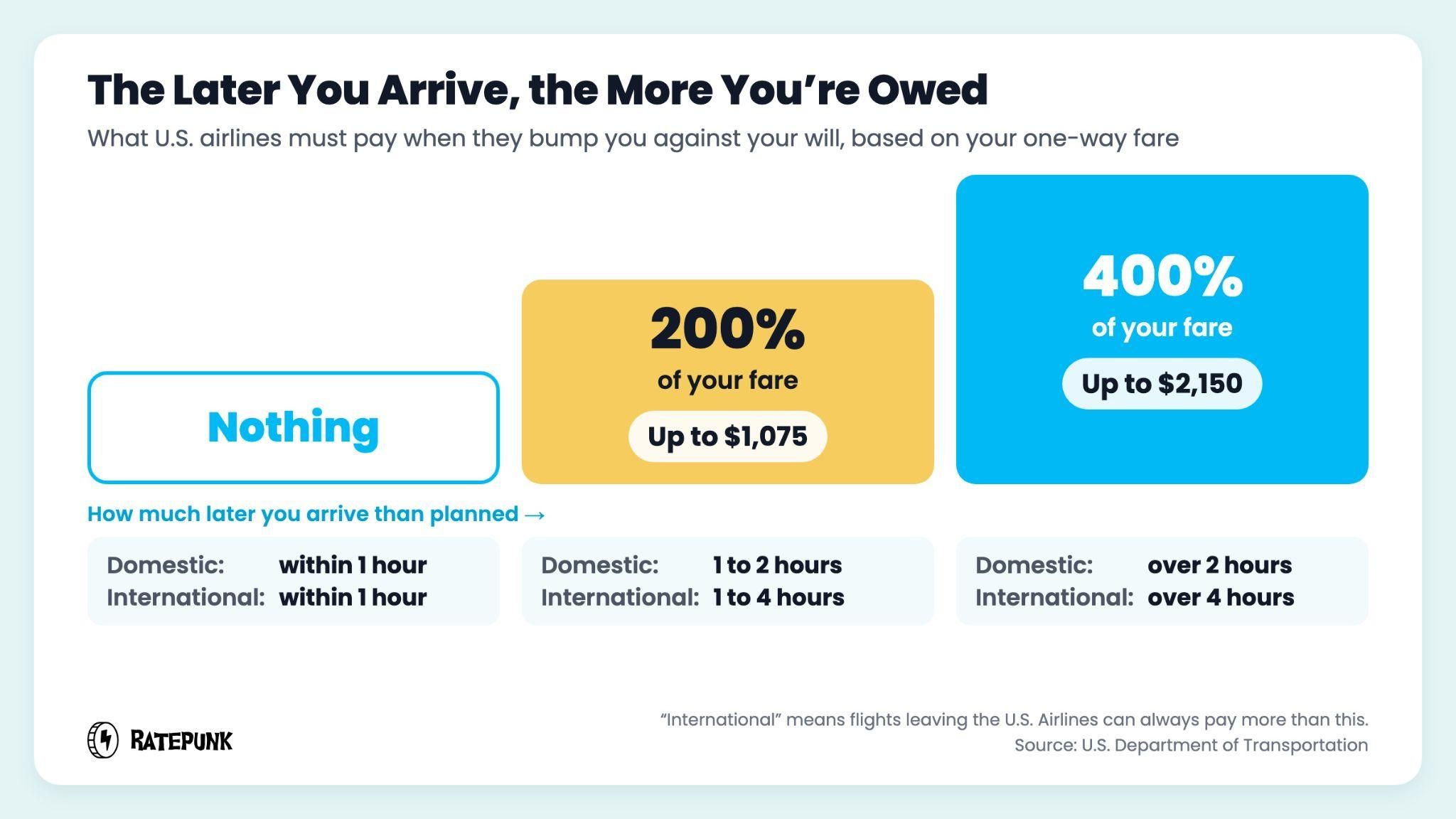
What U.S. airlines owe when they bump you against your will, from the U.S. Department of Transportation. Domestic flights: nothing if you arrive within an hour of your original time, 200% of your one-way fare up to $1,075 if you arrive 1 to 2 hours later, and 400% up to $2,150 after that. International flights from the U.S.: nothing within an hour, 200% up to $1,075 for 1 to 4 hours, and 400% up to $2,150 after 4 hours.
Before you do the math, a few details matter:
- Your fare is what you paid for your ticket, including mandatory taxes and fees, not what the same seat costs on the day you're bumped
- Have a round trip ticket? Then your payout's based on the one-way fare for the part of your trip you got bumped from. DOT's rules don't say how a round-trip price gets split, so ask the gate agent which amount they're using
- Have connecting flights? The clock stops when you reach your final stop for the day, not your next connection.
So what does that look like in real life? On busy short hops, it's more like a nice dinner out than a big payday. A usual nonstop one-way fare from Las Vegas to Los Angeles is about $55, so a bump with a long delay pays about $220.
Coast to coast, it's a different story. The usual nonstop one-way fare from Los Angeles to New York runs about $325, which turns a long-delay bump into about $1,300. Even so, none of the ten routes with the most fares in our data gets close to the caps, so for most trips it's your ticket price, not the cap, that sets your payout.

What you’re owed when a bump gets you there more than two hours after your original time, 400% of the usual nonstop one-way fare, rounded to $5: Los Angeles (LAX) to New York (JFK) $1,300, New York (JFK) to Los Angeles (LAX) $1,230, Charlotte (CLT) to Miami (MIA) $415, Houston (IAH) to Miami (MIA) $360, Denver (DEN) to Los Angeles (LAX) $290, Phoenix (PHX) to Los Angeles (LAX) $255, Atlanta (ATL) to Miami (MIA) $245, Los Angeles (LAX) to San Francisco (SFO) $240, San Francisco (SFO) to Los Angeles (LAX) $235, and Las Vegas (LAS) to Los Angeles (LAX) $220.
Who Qualifies for Denied Boarding Pay
"Denied boarding" is the official term for getting bumped. You qualify for denied boarding pay when all of these are true:
- You're flying out of a U.S. airport
- You have a confirmed reservation
- You checked in and got to the gate on time
- The airline can't get you to your destination within an hour of your original arrival time
Miss any one of those, and the cash rules don't apply.
Heads up, though. Some bumps pay nothing, even when you do everything right. That's the case when:
- The airline swaps in a smaller plane
- You're on a charter flight
- You're flying into the U.S. from another country
- The plane is small (fewer than 30 seats, or 60 seats when there's a weight or balance problem)
The good news? The same habits that make you eligible also help keep you on the plane. Check in on time and get to the gate early, because once a gate agent scans your boarding pass, the airline generally can't bump you, except for safety, security, health, or behavior reasons.
Busy travel days and the holidays are when bumps are more likely, so give yourself a little extra time then. Not every airline oversells, either. The Department of Transportation notes that some airlines sell only as many tickets as there are seats, which makes a bump a lot less likely.
Volunteering on an Overbooked Flight
If your plans are flexible, volunteering to give up your seat on an overbooked flight can pay off nicely, because there's no legal limit on what an airline can offer you. Airlines have to ask for volunteers before they bump anyone, and you're free to haggle.
That's why some savvy travelers go hunting for full flights on purpose, especially around the holidays. Some of the busiest days to try your luck are the Wednesday before Thanksgiving, the Sunday after, December 23, December 27, and January 3.
Days when airlines are scrambling can pay off too. When the FAA issued a nationwide ground stop on November 13, 2026, about 12,462 flights were canceled that day. After days like that, the last flights fill up with stranded travelers, so if you have time to spare, your seat can be worth more.
Airlines really do lean on volunteers: Delta alone took 126,601 of them in 2025.
Here's the trick. Before you raise your hand, the airline has to tell you whether you could be bumped against your will and what you'd be owed then. On a short route, that might only be a couple of hundred dollars, so hold out for an offer that beats it.
Before you say yes, ask three quick questions:
- When the next flight with a confirmed seat leaves, since standby on a full flight can leave you stuck at the airport
- Whether the airline will cover meals, a hotel, and the ride to and from it
- How long the voucher lasts, and whether you can use it over the holidays or on international flights
And when you can, haggle for cash instead of a voucher. Airlines are allowed to offer either, and you're free to negotiate, so it never hurts to ask.
Who Gets Bumped First
When not enough people volunteer, each airline picks who gets bumped using its own rules. Those rules usually look at:
- Your fare price
- Your frequent flyer status
- When you checked in
The rules can't be discriminatory, and anyone who gets bumped is owed a written statement explaining how the airline decided.
Frequent flyer status and pricier cabins usually help you keep your seat, since Delta, United, and American all count them when deciding. Delta also looks out for travelers who were rebooked after an issue on an earlier flight, putting them ahead of other passengers without boarding passes.
How often it happens depends a lot on which airline you fly. Here's how many people each airline bumped against their will in 2025:
- Delta and Allegiant: no one
- Southwest: 226
- United: 309
- American: 14,758, more than any other airline in the Department of Transportation's report
How to Get Paid When Bumped
If you're bumped against your will, the airline has to offer you your money at the airport that same day, or within 24 hours if your new flight takes off before they can pay you. And you don't have to settle for travel credit.
Here's your game plan at the gate:
- Ask for the written statement of your rights (which every bumped passenger is entitled to)
- Ask how much you're owed in cash or a check before you discuss travel credit
- Say no to the credit if you'd rather have the money, since you have the right to cash.
- Ask for more, since airlines are always allowed to pay above the minimum
If the airline offers free or cheaper flights instead, it has to tell you the cash amount first and spell out any strings attached. That way you can compare the two and pick whichever is worth more to you.
Frequently Asked Questions
Do you get bumped flight compensation if your flight is canceled?
No. A canceled flight isn't a bump, so bumped flight compensation doesn't apply.
That doesn't leave you empty-handed, though. If the airline cancels your flight for any reason and you decide not to travel, you're owed a refund, within 7 business days on a credit card or 20 days for other payment methods. Cancellations fall under the rules for delayed and canceled flights instead.
Which airline bumps the most passengers?
Frontier bumped the most passengers against their will for its size in 2025, about 2.51 for every ten thousand passengers, among the airlines the U.S. Department of Transportation reports on. American bumped the most people overall, while Delta and Allegiant didn't bump anyone against their will.
What happens if no one volunteers on an overbooked flight?
If no one volunteers, the airline picks who gets bumped using its own rules, like your fare price, frequent flyer status, and when you checked in. It has to ask for volunteers first and tell them they could be bumped against their will. Anyone who gets bumped is owed a written statement of their rights.
Can an airline bump you after you board?
Generally, no. Once you've checked in on time and a gate agent has scanned your boarding pass, your seat is yours, except for safety, security, health, or behavior reasons.
How much does Delta pay when it bumps you?
If Delta bumps you against your will, it owes you the same as any U.S. airline: 200% or 400% of your one-way fare, up to $1,075 or $2,150, depending on how much later you arrive.
Volunteers get whatever Delta offers, in an amount and the form it decides. But Delta hasn't been forcing people off lately: in 2025, it didn't bump a single passenger against their will and relied on volunteers instead.
How We Got These Numbers
The rules and compensation amounts in this guide come from the U.S. Department of Transportation and the airlines’ own websites, and the bumping counts come from the Department of Transportation’s Air Travel Consumer Report. The fares come from nonstop one-way flight searches RatePunk tracked on the ten U.S. routes with the most of those fares in our data, mostly three weeks to four months before departure. Southwest is thin in our data, so its routes aren’t among them. These are prices shown in searches, not prices people paid.
If you found this interesting, you might also enjoy these articles:
- U.S. Delayed Flight Compensation: What Changes in 2027?
- The Worst Airlines in the US [2027], Ranked by DOT Data
- Thanksgiving Airfare 2026: Price Hikes Skipped the Holiday
- Flying With a Cold or the Flu: What You Can and Can’t Do
- 10 Ways to Find Cheap Flights in 2027, Tested With Real Fares
About RatePunk
Reading fares and understanding what makes them move is our area of expertise, and the prices in this article come from our own flight data. We built RatePunk Flights, a paid membership that watches prices out of the airport you fly from. We'll alert you when a lower fare pops up, so you can book it wherever you like, with the airline itself or a travel site you already use.
November 19, 2026