
Cheap Flights from Australia to Thailand: A Data-Driven Guide (2026)
Fly to Thailand for a median return of A$790. Discover why regional beach hubs like Krabi bypass Bangkok's premium and when to book to avoid the December peak.
By RatePunk Research · Updated 2026-05-27
The price of paradise: Australia to Thailand flight reality
Thailand is celebrated as a budget-friendly escape, but the aviation corridor from Australia is structurally split. While travellers expect cheap entry across the board, our analysis of over 2.4 million searches reveals a market heavily weighted toward high-volume direct routes. The overall average fare sits at A$1,047 return, driven upward by the sheer volume of travellers funneling into major hubs.
This price difference is highly concentrated. Direct routes to Bangkok and Phuket City account for nearly 85% of all passenger traffic, with Phuket averaging a steep A$1,112. Because Australia’s geographical isolation limits cheap overland alternatives, airlines command high margins on these primary direct flights.
True value in this corridor requires looking past the obvious gateways. Secondary destinations like Krabi offer a dramatic discount, averaging just A$704 return. For Australian travellers, unlocking Thailand's famous affordability requires finding alternative entry points or timing booking windows to escape the high pricing structure.
Related guides: - Flights from Australia to Vietnam
When to fly: Navigating the December peak
Australia’s rigid summer holiday calendar creates a severe distortion on the corridor to Thailand. Because statutory leave and school terms concentrate travel into a narrow window, December fares surge to a massive 165.6% of the baseline average. This peak is not a gradual climb. It is a sharp, seasonal spike that penalises anyone bound to school holidays, while January remains highly inflated at 134.5%.
For travellers, this extreme concentration means the direct flights to Bangkok and Phuket become prohibitively expensive at the end of the year. The data shows a dramatic drop-off immediately after the holidays. By February, the price index plummets to 73.2%, and it bottoms out in May at 70.8%.
If you want to experience Thailand without paying the holiday tax, avoid the December peak entirely. The smartest strategy is to target the shoulder months of February or May, where the price index drops by more than half. If you must travel during peak periods, look for connections via secondary hubs to bypass the direct-flight pricing pressure.

Monthly price index for flights from Australia to Thailand. Index = 100 is the annual average. Peak: December (166). Trough: May (71).
How early to book: The 90-day sweet spot
Booking 60 to 120 days ahead is the safest strategy for securing a competitive fare to Thailand. While our analysis of over 2.4 million searches reveals that the absolute lowest median price sits at A$681 in the 120-day bucket, the pricing floor remains remarkably stable all the way down to 30 days out (A$724).
This stability represents a critical window for travellers. Booking earlier than 180 days out is actually a penalty, with median fares climbing back to A$904 at the 240-day mark. This happens as airlines initially release higher-priced fare buckets. Conversely, waiting until the final two weeks causes prices to spike sharply to A$1,096.
For those looking to shave extra dollars off the ticket, departure day choice offers a modest but useful optimization. Monday and Sunday departures offer a slight discount, with a median of A$696, while mid-week departures, particularly Thursdays, command a higher price.
Our recommendation is to lock in your flights around the 90-day mark on a Sunday departure. This secures the pricing floor while preserving a healthy selection of direct routes before inventory tightens and forces you onto longer, multi-stop journeys.
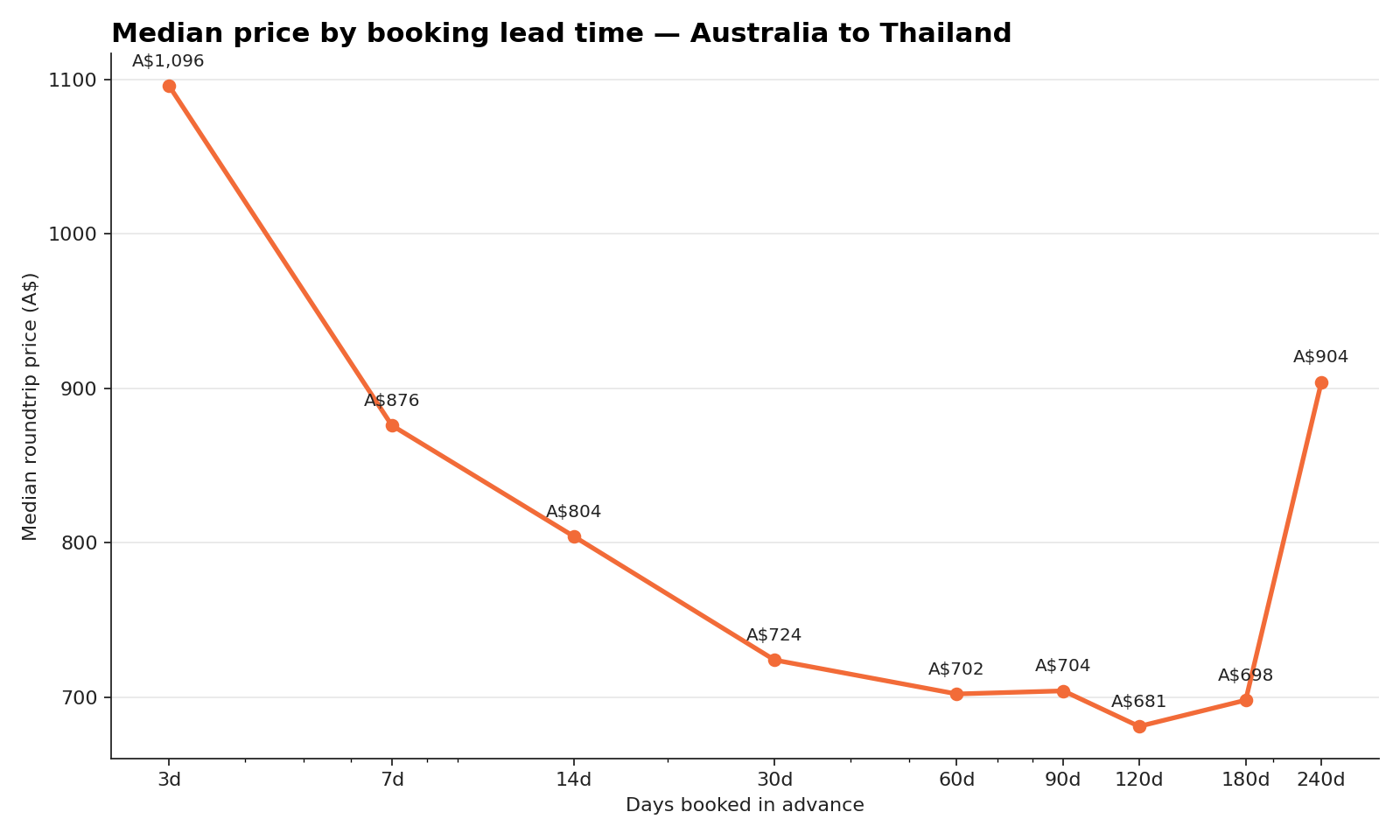
Median roundtrip fare by booking-window length (days before departure) for flights from Australia to Thailand. Based on n/a search snapshots.
Where to fly: The primary and secondary hub split
Thailand is often treated as a uniform budget destination, but our search data reveals a steep pricing gradient across its gateways. Bangkok and Phuket City together absorb over 84% of all Australian traveler volume, yet this heavy concentration on primary direct routes comes with a price markup. Travelers bound for Phuket City face an average return price of A$1,112, driven by high holiday demand.
In contrast, secondary gateways offer a stark discount. Krabi, for instance, represents the floor of this corridor at an average of A$704—nearly A$408 cheaper than Phuket. This wide spread shows that the real savings in Thailand require looking past the dominant routes.
| Rank | City | Avg roundtrip | Share of pair |
|---|---|---|---|
| 1 | Bangkok | A$1,007 | 53.6% |
| 2 | Phuket City | A$1,112 | 31.2% |
| 3 | Ko Samui | A$1,265 | 7.0% |
| 4 | Chiang Mai | A$882 | 3.4% |
| 5 | Krabi | A$704 | 2.2% |
| 6 | Pattaya | A$1,096 | 1.0% |
| 7 | Udon Thani | A$833 | 0.3% |
| 8 | Chiang Rai Province | A$876 | 0.2% |
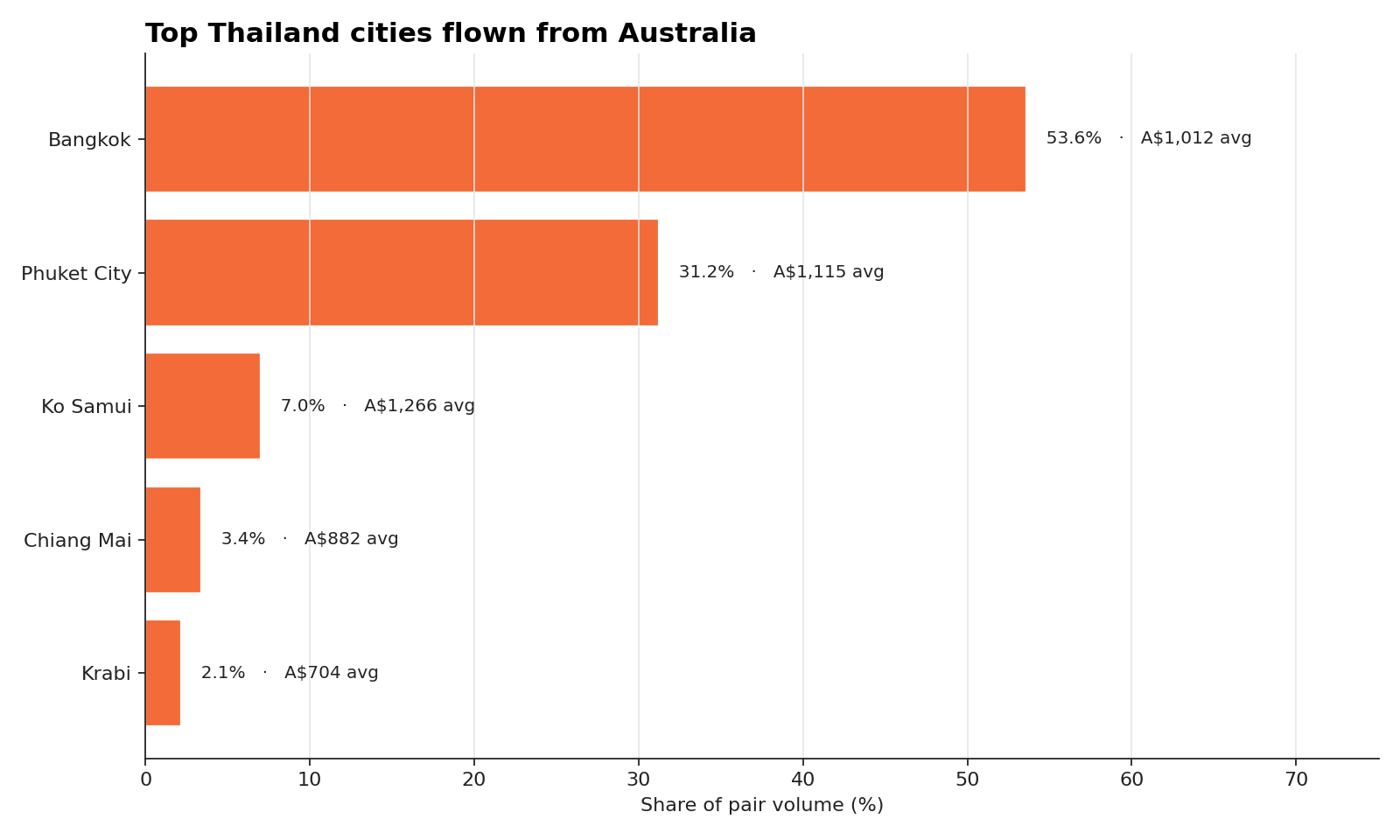
Top destination cities within Thailand for flights from Australia to Thailand. Fares show both the average and the typical (median) roundtrip; share figures are each city's percentage of the country's search volume.
The Bangkok gravity well
Bangkok functions as the heavy volume hub of the Australian-Thailand corridor, capturing 53.6% of all traffic across our sample of over 2.4 million searches. This massive volume represents a highly competitive route where legacy carriers and low-cost operators constantly battle for market share. The result is a median fare of A$1,007, which undercuts the national average for Thailand by A$40. By contrast, Phuket City attracts a smaller 31.2% share of travellers but commands a steep price markup, pushing average fares up to A$1,112.
This pricing spread reveals a clear split for Australian travellers. The extra cost on direct flights to Phuket City suggests that holidaymakers are paying a steep convenience tax to fly straight to the beach. One likely explanation for Bangkok’s lower price point is the sheer density of connecting flights and airline choices, which forces carriers to keep their margins thin. If your ultimate destination is southern Thailand, booking a direct flight to Phuket City might seem easier, but it is rarely the most economical choice.
To secure the best value on this corridor, we recommend booking your long-haul flight into Bangkok first, rather than purchasing a single ticket to the islands. Because regional carriers heavily discount secondary domestic connections within Thailand, buying a separate local ticket from Bangkok to Phuket City or Krabi can frequently shave hundreds of dollars off your total trip cost. This two-step booking strategy allows you to exploit the highly competitive pricing on the main route while avoiding the direct-flight pricing markup.
Which Australian airport offers the cheapest escape?
Geographic proximity gives Perth an unmatched pricing advantage over the East Coast, creating a starkly divided market where your departure city dictates your entire booking strategy. While travelers flying out of Sydney, Melbourne, and Brisbane face average fares well over the thousand-dollar mark—averaging A$1,028 across the eastern hubs—Perth is a geographical outlier with a median return fare of just A$651. This price gap is not a temporary discount. It is a permanent geographical dividend driven by low-cost carriers capitalizing on the shorter flight path.
For Western Australians, Thailand is a highly accessible short-haul getaway. If you are based in the east, trying to route through Perth to save money is a false economy. The domestic transit costs and extra travel time will quickly wipe out the fare difference. East Coast travelers should instead focus on timing their direct bookings or targeting secondary airports like Bangkok's Don Mueang to find comparable value.
Three bookings most travellers miss
- Flying from Perth to Krabi avoids the high-cost resort gateways, offering a direct alternative that lands 31.0% below the regional baseline fare (n=29,947 searches).
- Choosing Sydney to Hat Yai instead of the major routes cuts typical transit costs by 38.2%, proving that routing to southern secondary hubs avoids the main-corridor pricing markup (n=1,849 searches).
- Opting for Perth to Bangkok's secondary hub at Don Mueang (DMK) rather than the primary international gateway delivers a 26.8% discount, showing how airport selection alters the pricing logic on high-volume routes (n=39,554 searches).
- Booking Sydney to Surat Thani Province offers a 25.9% saving against the baseline, positioning this secondary gateway as a highly discounted entry point to the southern islands (n=1,108 searches).
Frequently asked questions
Which Thai city is the cheapest to fly into from Australia?
Krabi is the cheapest gateway in our dataset, with a remarkably low average price of A$704, followed by Chiang Mai at A$882. This stands in stark contrast to the heavy routes of Bangkok and Phuket, which command steep pricing markups of A$1,007 and A$1,112 respectively.
What is the cheapest month to fly to Thailand?
May is the absolute cheapest month to fly, with a price index of 70.8 points. If you must travel during the peak holiday season in December, expect to pay more than double the off-peak rate as the price index climbs to a massive 165.6 points.
How far in advance should I book my flights to get the best deal?
The sweet spot for booking is 60 to 120 days out, where the median price drops to its lowest point of A$681. Booking earlier than 180 days actually penalises you, with fares 240 days out averaging a much higher A$904 as airlines initial-price their inventory conservatively.
Can Australians travel to Thailand visa-free?
Yes, Australian passport holders benefit from excellent global mobility—ranking 7th on the Henley Passport Index with visa-free access to 182 destinations—and can enter Thailand visa-free for tourism purposes for up to 60 days.
Is it cheaper to book a last-minute flight to Thailand?
No, waiting until the last minute is a costly gamble; flights booked within 3 days of departure jump to a median of A$1,096. While fares drop to A$804 at the 14-day mark, we recommend securing your tickets at least 30 to 60 days out (averaging A$724 to A$702) to balance low prices with actual seat availability.
Never overpay for your Thai getaway
With direct routes to Bangkok commanding a steep price markup, finding value on the Thailand corridor requires tracking volatile secondary connections and sudden booking windows. Ratepunk's price-tracking browser extension monitors these specific shifts, alerting you the moment a discount window opens on your route. Install the RatePunk extension to lock in the savings.
Methodology
We base our analysis on anonymised flight-search records from Ratepunk’s flight-price dataset, tracking combined economy-class fare searches. This study is built on a sample of 2,414,386 searches across 30 distinct routes, captured between 5 August 2025 and 7 May 2026.
These records cover departures scheduled throughout that same period, allowing us to map pricing trends across both peak holiday periods and the shoulder seasons. All prices cited in this article are in Australian Dollars (AUD) and reflect median return fares, unless stated otherwise.
May 29, 2026