
Cheap Flights from Australia to United Kingdom: A Data-Driven Guide (2026)
Flying from Australia to the UK? Our data reveals a massive A$2,252 average fare, but booking 14-30 days out and choosing secondary airports saves hundreds.

By RatePunk Research · Updated 2026-05-29
Key findings
The extreme physical distance of the kangaroo route imposes a heavy baseline cost on travel to the United Kingdom, but the assumption that booking early is the only way to survive this long-haul markup is wrong. Across more than 40 million flight searches in our dataset, the median return fare from Australia to the UK sits at A$1,956. This high price floor is driven by geography, yet the pricing mechanics of this corridor reveal an unexpected vulnerability.
While conventional advice warns against last-minute bookings for long-haul flights, our data reveals a highly sensitive pricing sweet spot between 14 and 30 days before departure. During this narrow window, airlines frequently adjust pricing to fill remaining inventory. Travellers who pair this close-in booking window with secondary gateways like Bristol—which carries a median fare of A$1,838, undercutting even London's dominant hub—can bypass the steep markups typically exacted by direct-entry points. Understanding these patterns allows travellers to exploit capacity realities rather than paying the standard distance tax.
Related guides: - Flights from Australia to Italy
The December peak and the February trough
The extreme distance of the kangaroo route makes flight pricing highly sensitive to seasonal demand, creating a massive swing between peak and off-peak periods. Australia's school holidays and summer shutdown norms drive a dramatic price surge in December, where the monthly index spikes to 157.5. This peak is not a gradual climb but a sharp, localized surge; by February, the index collapses to its annual low of 74.8.
This dramatic drop of more than 80 points reveals a major opportunity for anyone with flexible travel dates. The post-holiday drop-off is so steep that delaying a trip by just six weeks can cut the baseline flight cost in half.
If you must travel during the southern hemisphere summer, avoid the December rush entirely. Instead, target the late-January shoulder or, ideally, February. For those bound by rigid December dates, the only way to bypass this seasonal markup is to avoid direct-entry hubs like London and look at secondary gateways where regional capacity helps absorb the holiday surge.

Monthly price index for flights from Australia to United Kingdom. Index = 100 is the annual average. Peak: December (158). Trough: February (75).
The close-in booking paradox
Conventional long-haul wisdom dictates booking a flight to Europe at least six months in advance. However, for travellers heading from Australia to the United Kingdom, locking in tickets early often incurs a steep markup. While the typical median fare for this country-pair sits at A$1,956, our analysis of 2.6 million search records reveals that the curve actually softens significantly closer to departure.
The cheapest, most reliable window to secure a flight is between 14 and 30 days out, where median prices drop to A$1,678. This late dip is largely a statistical artifact of airline inventory management. As departure approaches, remaining seats on highly inconvenient, multi-stop itineraries are heavily discounted to clear inventory, which drags the median down. However, the actual choice of comfortable, single-transit routes collapses, leaving last-minute bookers with gruelling layovers.
For a more predictable journey, aim for midweek departures. Tuesday departures offer a modest discount with a median of A$1,779 compared to the Friday peak of A$1,976. Booking within the 14-to-30-day window remains the best balance of competitive pricing, provided you can tolerate the inventory traps of the last-minute market.
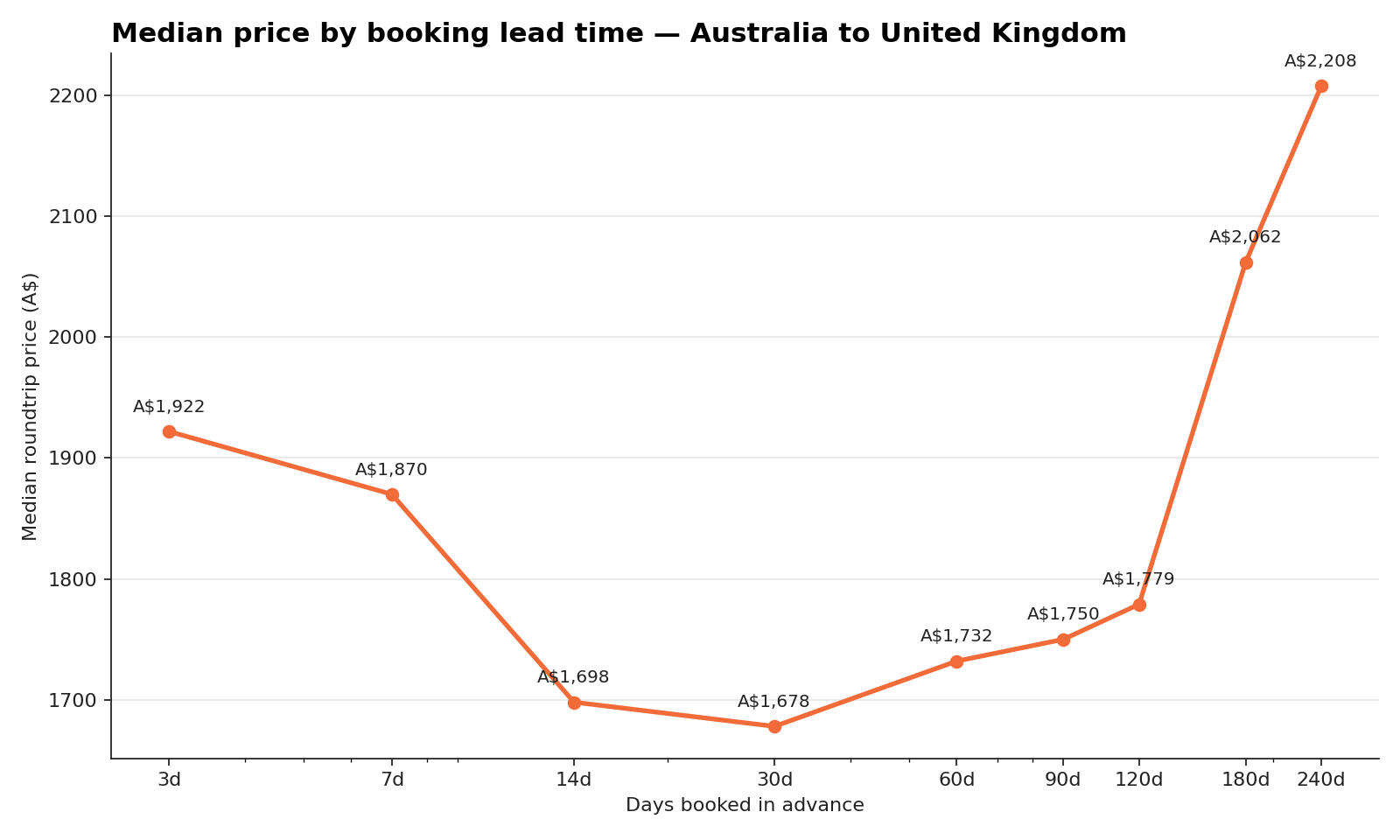
Median roundtrip fare by booking-window length (days before departure) for flights from Australia to United Kingdom. Based on 2,691,313 search snapshots.
Where in the United Kingdom to fly
London dominates the kangaroo route, capturing 75.1% of all Australian traffic to the United Kingdom. This massive concentration of demand usually positions the capital as the default entry point, but it also creates a steep price floor during peak periods.
The opportunity for travellers lies in the highly fragmented tail of secondary regional gateways. While major hubs like Manchester absorb the next largest share of traffic at a markup, smaller entry points like Bristol actually undercut London's median pricing by targeting different airline networks. Understanding this distribution allows travellers to bypass the traditional London bottleneck entirely by matching specific regional arrivals to the optimal booking window.
| Rank | City | Avg roundtrip | Median roundtrip | % of country searches |
|---|---|---|---|---|
| 1 | London | A$2,191 | A$1,864 | 75.2% |
| 2 | Manchester | A$2,385 | A$2,079 | 11.0% |
| 3 | Edinburgh | A$2,466 | A$2,312 | 6.6% |
| 4 | Birmingham | A$2,363 | A$2,196 | 2.3% |
| 5 | Newcastle upon Tyne | A$2,486 | A$2,145 | 2.1% |
| 6 | Glasgow | A$2,529 | A$2,328 | 1.3% |
| 7 | Belfast | A$2,392 | A$2,212 | 0.3% |
| 8 | Bristol | A$2,170 | A$1,838 | 0.3% |
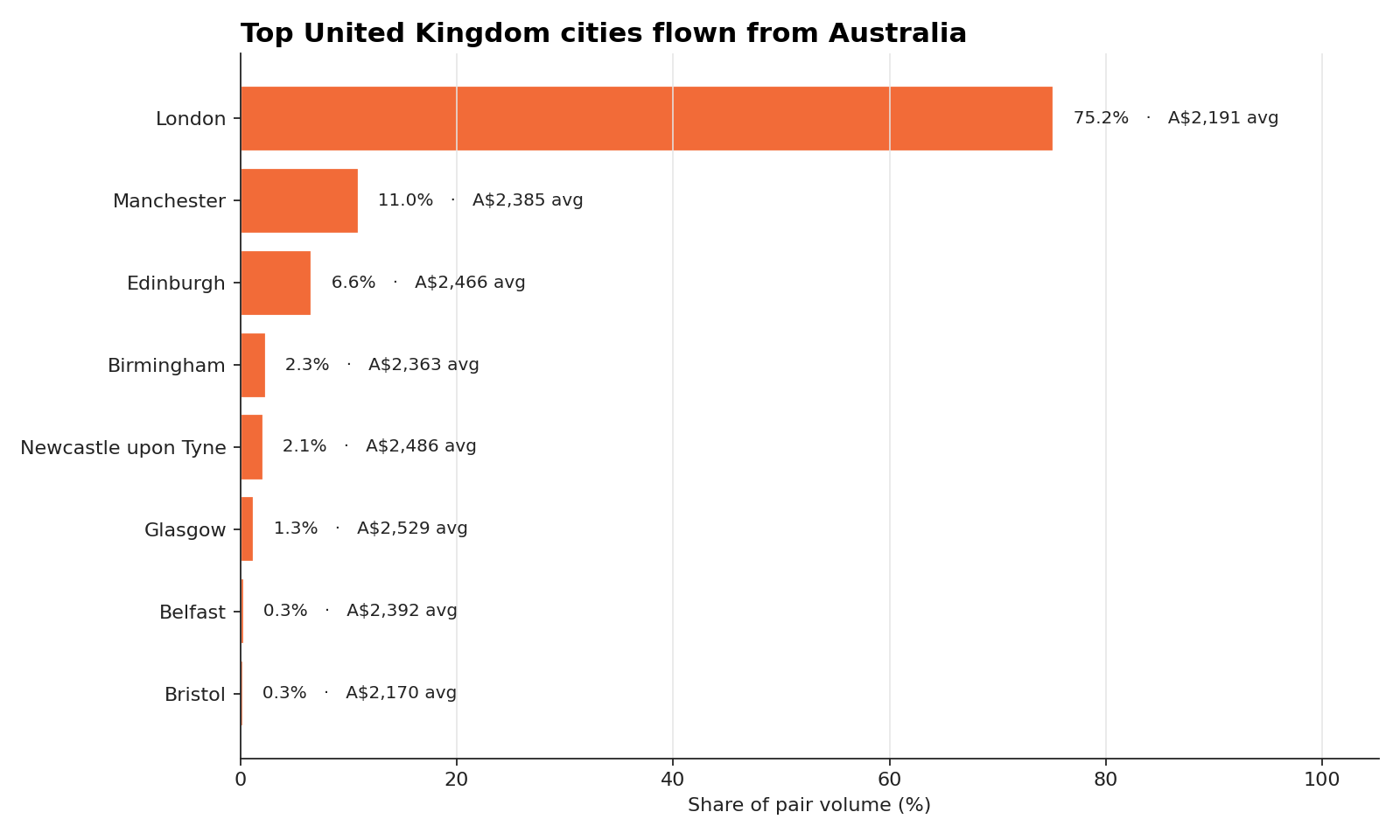
Top destination cities within United Kingdom for flights from Australia to United Kingdom. Fares show both the average and the typical (median) roundtrip; share figures are each city's percentage of the country's search volume.
Why London dominates the kangaroo route
London dominates the Australian outbound market to the UK, capturing 75.2% of all flight searches in our dataset. This massive concentration of traffic creates a paradox for travellers. While London Heathrow serves as the default entry point, its sheer volume masks a steep pricing markup. The median fare for London sits at A$1,864, but this combined figure hides a highly fragmented airport ecosystem. Our search data reveals that the markup is heavily concentrated at Heathrow, whereas secondary London gateways—specifically London Gatwick—frequently offer a relief valve for those willing to bypass the primary hub.
For travellers, this concentration means that booking the default route to Heathrow often results in overpaying for convenience. From Brisbane, for example, London Gatwick captures a substantial 25.5% share of hub searches, reflecting a conscious shift toward lower-cost secondary infrastructure. One likely explanation for this pattern is that low-cost carriers and alternative routing options concentrate their inventory at Gatwick, driving down the price floor. If your final destination is anywhere in the south of England, routing your search specifically to Gatwick rather than London as a whole can yield immediate savings without requiring a detour to a regional city.
We recommend looking past the combined London search results and actively separating your queries by airport code. If you are flying from Sydney or Melbourne, where Heathrow accounts for over 61% of all UK-bound traffic, check Gatwick fares explicitly during your planning. Furthermore, do not discount minor gateways like Bristol, which holds a tiny 0.3% market share but boasts the lowest median price in the entire dataset at A$1,838. If your travel dates are fixed, targeting these secondary entry points is the most reliable way to bypass the high baseline cost of the kangaroo route.
The price of departing from regional Australia
While Sydney and Melbourne command over half of all UK-bound flight searches from Australia, travellers departing from secondary hubs face a steep geographic and cost premium. Our search data reveals that average fares from Sydney (A$1,987) and Melbourne (A$2,043) benefit from concentrated airline competition, whereas Brisbane and Adelaide departures carry a significant surcharge, averaging A$2,183 and A$2,232 respectively. For travellers outside the major southeastern gateways, this means that accepting a domestic transfer to Sydney or Melbourne is often the only way to break through the high baseline cost of the kangaroo route. If you are flying out of Brisbane or Adelaide, do not assume your local airport is the most economical starting point; booking a separate domestic connection to a primary hub can easily save you more than the cost of the positioning flight, especially when targeting secondary UK destinations like Manchester to bypass London's direct-entry markup.
Three bookings most travellers miss
- Hobart to Birmingham bypasses the typical capital-city markup entirely, offering a median fare of A$1,001 that sits 37.4% below the baseline expected for this long-haul corridor (n=1,468 searches).
- Travellers departing the Gold Coast for Manchester avoid the steep Sydney or Brisbane hub markups, securing a 30.6% discount against the standard regional baseline (n=1,325 searches).
- Flying out of Avalon to London Gatwick instead of Melbourne Tullamarine provides a pricing loophole, cutting median itinerary costs by 29.8% (n=1,777 searches).
- Brisbane to London Southend routes around the primary hub tariff, yielding a median price of A$1,384 that represents a 23.7% savings compared to standard London-bound flights (n=3,036 searches).
FAQ
When is the cheapest time of year to fly from Australia to the UK?
Our data shows that February is the cheapest month to fly, with a price index of 74.8, while December is the most expensive at 157.5. This represents an 82.7% price swing between the peak holiday season and the late-summer trough, meaning a trip in February can save you hundreds of dollars compared to a Christmas departure.
How far in advance should I book my flight to get the best rate?
Counterintuitively, the cheapest booking window is 14 to 30 days before departure, where median fares drop to A$1,678. However, we do not recommend waiting this long if you have rigid dates, as this dip reflects airlines clearing unsold inventory; booking 14 to 30 days out offers the best price, but booking earlier provides better seat selection.
What is the typical cost of a return flight from Australia to the United Kingdom?
Across our dataset, the typical median return fare is A$1,956, while the overall average price sits at A$2,252. The gap between these numbers indicates that a small volume of high-priced, last-minute bookings pulls the average up, though most travellers pay closer to the median.
Which UK airport is the cheapest to fly into?
While London Heathrow (LHR) handles 75.2% of the traffic with a median fare of A$1,864, Bristol (BRS) is actually the cheapest gateway with a median fare of A$1,838. If your final destination is in the south or west of England, targeting Bristol bypasses the markup of London's major hubs.
Is it cheaper to fly into London or a regional UK city?
Excluding Bristol, regional entry points carry a significant markup: Manchester (MAN) averages A$2,385 and Edinburgh (EDI) averages A$2,466, compared to London's average of A$2,191. Unless you find a rare promotional fare, it is generally more economical to fly into London and use domestic rail or air connections to reach the regions.
Do Australian passport holders need a visa to enter the UK?
No, Australian citizens do not require a visa for tourist visits to the United Kingdom. Australia holds a Henley passport rank of 7, granting visa-free access to 182 destinations, which allows for hassle-free entry at the border for stays of up to six months.
The kangaroo route's high price floor makes timing critical, especially when targeting the volatile 14-to-30-day window for secondary UK gateways. RatePunk's real-time price tracker monitors these close-in fluctuations on your exact route, alerting you the moment airlines drop unsold inventory. Install the RatePunk extension to let the data work for you.
Methodology
This analysis is built on Ratepunk’s flight-price dataset, drawing from a global pool of 40,688,214 anonymised economy-class searches across 22,792 routes. The search records used for this study were captured between 5 August 2025 and 7 May 2026, covering scheduled departures spanning 5 August 2025 through 30 April 2027. All pricing figures are calculated and cited in Australian Dollars (A$).
To keep comparisons consistent, our destination and city tables report both the average and the typical (median) fare. Booking-window and weekday figures are calculated as medians to prevent single-ticket outliers from skewing the recommendation, while our seasonality charts use an index where 100 represents the annual average.
May 29, 2026