
Cheap Flights from Australia: A Data-Driven Guide (2026)
Discover how Australia's isolation shapes flight prices. See why Denpasar dominates outbound travel and how to navigate the A$2,191 average fare to London.

By RatePunk Research · Updated 2026-05-29
The geography tax on Australian travel
Australian travellers face an unavoidable geographic tariff on almost every international flight they take. With 86.8% of outbound travel classified as long-haul, the sheer distance to traditional hubs in Europe and North America imposes a steep, structural cost on the standard holiday.
This isolation has turned Indonesia into a mathematical necessity rather than a simple lifestyle choice. Across more than 40 million flight searches in our dataset, Indonesia functions as the ultimate budget pressure valve for the entire country. However, this relief is highly concentrated. Within Indonesia, search volume is heavily distorted, with Denpasar absorbing the vast majority of the demand. For Australians looking to escape the high cost of long-haul corridors, Bali is not just a popular getaway—it is the only scale-sized destination where geographic proximity keeps the entry price affordable.
The Bali vent: Australia's primary budget release valve
Australian travellers face a steep geographic tariff on almost every international flight path. With an isolation index of 0.90, the continent's physical distance from major northern-hemisphere hubs turns trips to Europe or North America into expensive, long-haul investments. To escape this financial pressure, the outbound market relies on a single, highly concentrated destination: Indonesia. Our search data shows that Indonesia captures nearly 7% of all Australian outbound flight searches, with a remarkably low median return fare of A$574.
However, this demand is not distributed evenly across the Indonesian archipelago; it is almost entirely concentrated on a single runway. Denpasar alone commands an astonishing 88.6% of all Australian demand for Indonesia, representing over 2.9 million searches in our dataset. By comparison, the capital city of Jakarta handles just under 5% of the volume, while alternative getaways like Praya, Lombok attract a mere 1.4%. This extreme concentration shows that Bali is a key financial anchor. High airline capacity and intense competition on this route consistently keep prices low.
For budget-conscious travellers, this data yields a clear strategy: do not look for alternative Indonesian gateways expecting to find cheaper, untouched paradises. Flying from Sydney to Denpasar or Melbourne to Denpasar remains cheap because low-cost carriers flood these specific routes with capacity. Trying to game the system by booking into Jakarta (median fare A$658) or Balikpapan (median fare A$890) actually increases your flight costs significantly. If you want to explore beyond Bali, your best financial move is to fly into Denpasar first to secure the cheap baseline fare, and then use local, domestic connections to reach your final destination.
Australia's most searched international flight corridors
Australian travellers face an inescapable geographic tariff. Flying to traditional long-haul hubs in Europe or North America requires crossing vast distances, resulting in a median roundtrip price of A$1,868 to London.
To offset these high costs, the outbound market relies on a crucial regional alternative. Indonesia acts as a mathematical necessity for budget-conscious travellers rather than just a leisure preference, with Denpasar commanding over 6% of all search volume at a highly accessible median roundtrip price of A$550. The top twenty destinations reveal this stark split: highly concentrated, low-cost Asian and Pacific escapes on one side, and expensive, long-haul corridors on the other.
| Rank | Destination | Country | Avg roundtrip | Median roundtrip | Share |
|---|---|---|---|---|---|
| 1 | Denpasar | Indonesia | A$736 | A$550 | 6.0% |
| 2 | London | United Kingdom | A$2,191 | A$1,868 | 5.0% |
| 3 | Tokyo | Japan | A$1,437 | A$1,092 | 3.6% |
| 4 | Bangkok | Thailand | A$1,012 | A$750 | 2.7% |
| 5 | Singapore | Singapore | A$910 | A$699 | 2.3% |
| 6 | Ho Chi Minh City | Vietnam | A$744 | A$496 | 2.1% |
| 7 | Auckland | New Zealand | A$763 | A$645 | 1.9% |
| 8 | Los Angeles | United States | A$1,934 | A$1,581 | 1.7% |
| 9 | Phuket City | Thailand | A$1,115 | A$808 | 1.6% |
| 10 | Rome | Italy | A$2,378 | A$2,064 | 1.4% |
| 11 | Osaka | Japan | A$1,154 | A$891 | 1.4% |
| 12 | Athens | Greece | A$1,895 | A$1,542 | 1.3% |
| 13 | Manila | Philippines | A$950 | A$723 | 1.3% |
| 14 | Nadi | Fiji | A$870 | A$676 | 1.3% |
| 15 | Paris | France | A$2,290 | A$1,956 | 1.2% |
| 16 | Amsterdam | Netherlands | A$2,029 | A$1,750 | 1.2% |
| 17 | Kuala Lumpur | Malaysia | A$808 | A$616 | 1.1% |
| 18 | Vancouver | Canada | A$2,368 | A$1,928 | 1.1% |
| 19 | Queenstown | New Zealand | A$743 | A$638 | 1.1% |
| 20 | Christchurch | New Zealand | A$801 | A$711 | 1.0% |
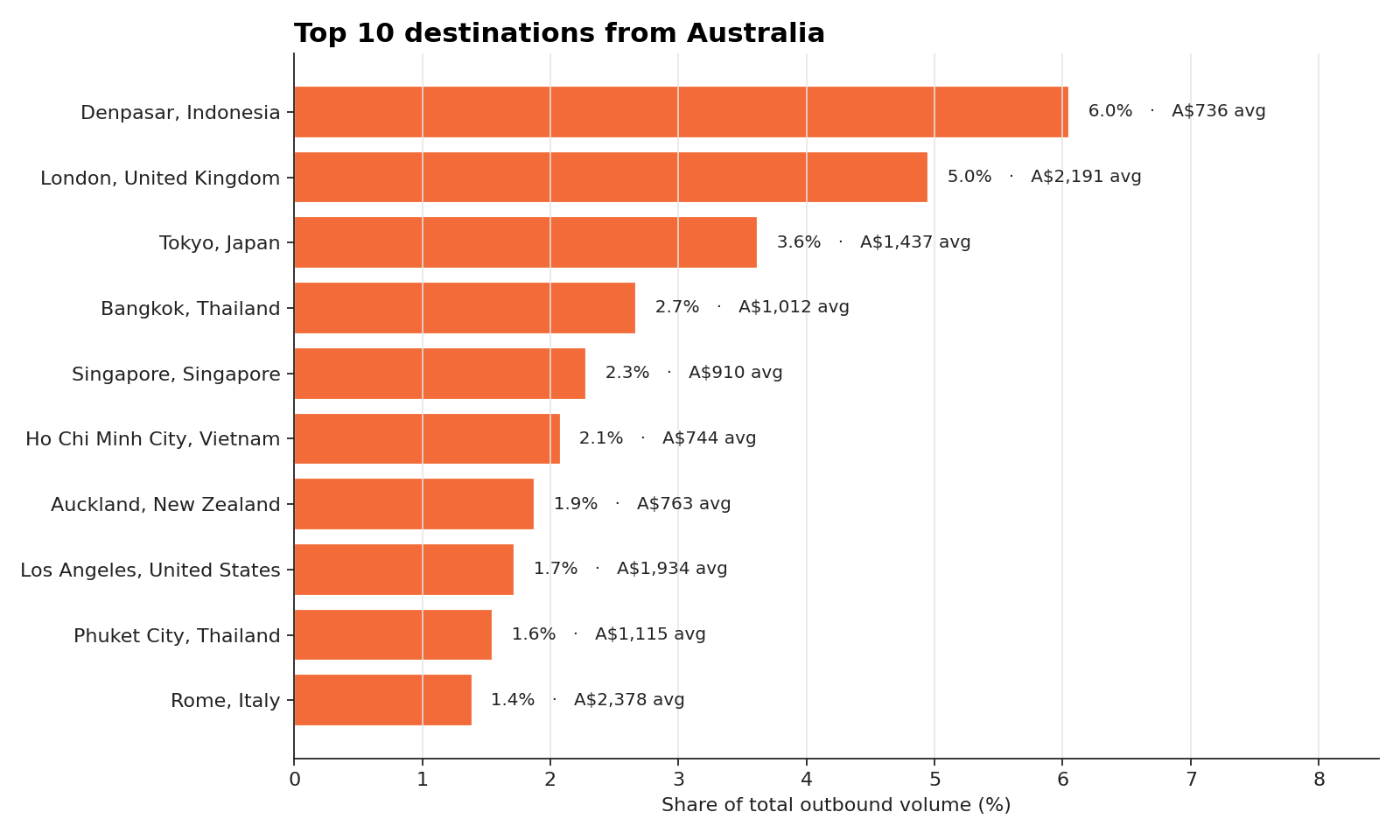
Top 20 destinations by search volume for flights from Australia. Fares show both the average and the typical (median) roundtrip; search share is each destination's percentage of all outbound queries.
Flights from Australia to Japan: the rising mid-haul alternative
Australian travellers facing high long-haul fares to Europe or North America often view Denpasar as their only financial escape route. However, Flights from Australia to Japan have emerged as a highly compelling mid-tier alternative that balances reasonable flight times with moderate pricing.
Our search data reveals the market reality of this corridor: while a flight to London carries a median roundtrip price of A$1,868, Tokyo sits at a far more accessible A$1,092. For those willing to bypass the capital, Osaka offers an even deeper discount with a median price of A$891.
This means you do not have to default to Indonesia to avoid a A$2,000 ticket. Japan functions as a crucial middle ground, offering a rich cultural contrast to Australia without the punishing price tag of transatlantic travel. If you are planning a trip, we recommend looking at multi-city tickets that arrive in Tokyo and depart from Osaka; this routing often captures the best pricing while eliminating the cost of a return domestic bullet train.
Flights from Australia to the United Kingdom: the premium long-haul anchor
If you want to understand the sheer scale of the distance-based pricing Australian travellers pay, look at Flights from Australia to the United Kingdom. London is our second most-searched international destination, but it carries a brutal financial premium. The median roundtrip fare to London sits at A$1,868 in our data, which is more than three times what you would spend to fly to Denpasar.
This pricing is an unavoidable geographic tariff on long-haul endurance. Because the distance is so vast, airlines cannot easily discount these seats, meaning competition only keeps a floor under the price rather than driving it down.
For your travel planning, this means you should not try to game the system by booking complex, multi-stop itineraries on separate tickets to save money. The single-ticket transit through Asian hubs remains the safest and most cost-effective way to absorb this distance. If you want to see Europe, accept the London entry price as a baseline, and use budget regional carriers once you are on the ground.
Flights from Australia to Thailand: the secondary South-East Asian escape
While Denpasar acts as Australia’s primary budget destination, flights from Australia to Thailand serve as the critical secondary option. For travellers priced out of long-haul flights to Europe, where a median ticket to London costs A$1,868, Thailand offers a highly competitive alternative.
Our search data reveals a clear pricing hierarchy. While Denpasar remains the cheapest escape with a median round-trip of A$550, Bangkok sits slightly higher at A$750, and Phuket City follows at A$808.
This price difference translates to a distinct choice for travellers. If you are priced out of Bali due to seasonal surges, Thailand is not just a lifestyle alternative; it is a mathematical backup plan. The extra A$200 to A$250 buys you escape from the heavy concentration of Australian regional traffic. We recommend watching the Bangkok route as your primary indicator. When Bali flights spike during school holidays, Thailand's pricing often remains stable, absorbing the excess demand at a far more reasonable rate than any long-haul flight.
Flights from Australia to New Zealand: the short-haul default
Australian travellers face an unavoidable distance-based premium on long-haul corridors. While Denpasar serves as the ultimate budget option, flights from Australia to New Zealand represent the country's only true short-haul international counterpart.
Across our search data, routes to Auckland, Queenstown, and Christchurch emerge as the default regional escape hatch. The median return fare to Auckland sits at A$645, while Queenstown averages A$638. These prices are mathematically comparable to flying to Bali, but they serve a completely different travel profile.
What this means for your trip: New Zealand is your low-friction, short-lead alternative when Southeast Asian heat or flight times do not fit your plans. You do not need to book six months ahead to escape the isolation tariff. If you see trans-Tasman fares hovering near the A$650 mark inside a 45-day departure window, lock them in—that is as close to a baseline price as this isolated market allows.
Flights from Australia to Vietnam: the emerging value corridor
Australian travellers face an unavoidable distance-based premium when flying long-haul, with a trip to London carrying a painful median price of A$1,868. To escape this geographic tariff, most holidaymakers treat Denpasar as a mathematical necessity for budget travel. However, our search data reveals a powerful alternative: Flights from Australia to Vietnam.
With a median round-trip price of A$496 to Ho Chi Minh City, this emerging corridor is actually cheaper than flying to Bali. What this means for your travel planning is that you do not have to default to Indonesia to secure a low-cost holiday. Vietnam now offers the absolute lowest entry price into South-East Asia from Australia, backed by a substantial 2.08% share of all outbound searches. If you are planning a budget getaway, we recommend looking beyond the traditional Bali route; tracking fares to Ho Chi Minh City yields a deeper discount without sacrificing the ease of a single-flight journey.
Flights from Australia to the United States: the trans-Pacific gateway
Crossing the Pacific reveals the true scale of the geographic tariff Australian travellers must pay. Our search data shows that Flights from Australia to the United States are heavily concentrated on a single West Coast gateway. Los Angeles (LAX) is the sole North American destination to make the top ten, capturing a 1.72% share of all outbound searches.
However, this access is expensive. The median round-trip fare to Los Angeles sits at A$1,581—nearly three times the A$550 median fare to Denpasar. While Indonesia acts as a cheap, high-volume alternative for Australian holiday budgets, the US corridor remains a highly consolidated market where airlines face little pressure to discount.
For travellers, this means trying to game your entry point into North America rarely works. Flying into alternative ports like Vancouver costs significantly more, with a median fare of A$1,928. If you want to visit the US, your best strategy is to fly into Los Angeles on a major carrier, lock in your ticket 90 to 120 days out, and use a domestic budget flight to reach your final destination.
Flights from Australia to Italy: the seasonal European pilgrimage
Flights from Australia to Italy represent the ultimate expression of the distance-based premium. While a quick escape to Denpasar offers a budget alternative with a median fare of A$550, crossing the hemisphere to Rome demands a serious financial commitment. Our search data reveals a median roundtrip price of A$2,064 to Rome, making it the most expensive European destination in the top ten.
This steep pricing is driven by extreme, highly seasonal leisure demand. Unlike regional Asian hubs that enjoy year-round capacity, European corridors face severe summer bottlenecks where airlines can command premium rates.
For travellers, this means trying to game the system with last-minute bookings to Italy is a losing strategy. The market reality of the route means seats sell out early. If you want to avoid the absolute peak of the geographic tariff, we recommend booking at least 120 to 180 days in advance or targeting shoulder months like May and September.
How your departure city dictates your flight options
Australia’s air travel market is split by a harsh geographic tariff, forcing major airports to operate either as diversified global gateways or as highly localized regional hubs. While East Coast hubs like Sydney and Melbourne maintain a balanced mix of premium long-haul routes to Europe and regional Asian flights, secondary gateways are almost entirely locked into short-haul leisure corridors. In these secondary markets, Denpasar (Bali) ceases to be a mere lifestyle choice and becomes a mathematical necessity. It functions as the only affordable option for budget-conscious travellers who are otherwise priced out of the exorbitant long-haul fares dictated by Australia's extreme isolation.
- Gold Coast (OOL): The ultimate regional hub, where Denpasar alone commands 16.1% of all outbound flight searches, leaving the hub entirely dependent on low-cost leisure routes to Indonesia and New Zealand with zero direct footprint in Europe or North America.
- Perth (PER): Capitalises on its geographic proximity to Asia to run a remarkably low average ticket price of A$1,245, with Denpasar capturing a massive 13.3% share of its market—nearly triple London's share from the same airport.
- Canberra (CBR): Lacking direct low-cost carrier density, the capital suffers the nation's highest average fare of A$1,785, proving that without a high-volume regional alternative, travellers pay a severe premium to bypass the isolation.
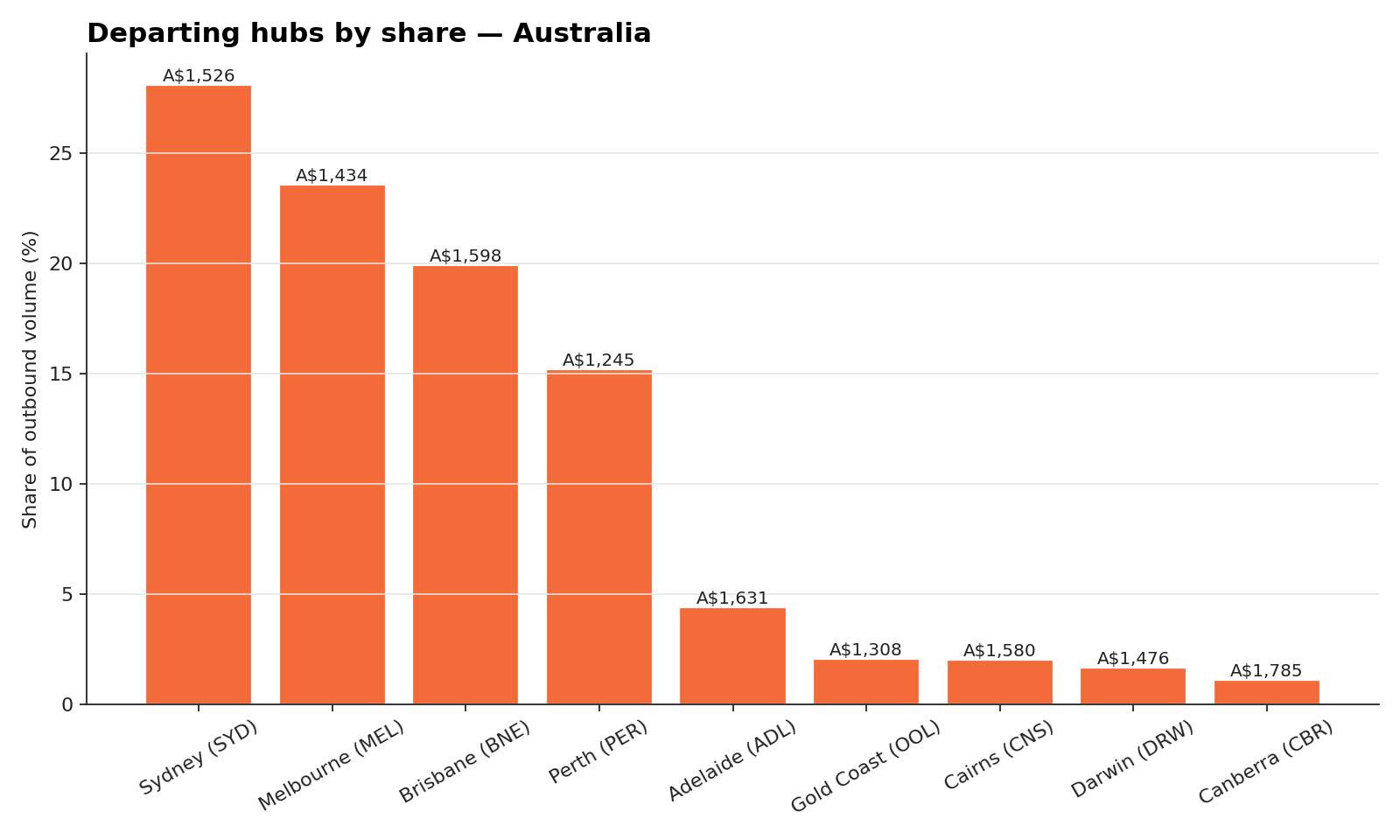
Share of outbound search volume by departing airport for flights from Australia. Top three hubs typically capture the majority.
The regional price tiers of Australian travel
Australian travellers face a stark, two-tiered reality dictated entirely by geography. Our flight data reveals a massive step-change in cost: the median ticket to South-East Asia sits at A$612, but crossing into Europe or North America instantly triggers an unavoidable geographic tariff, with median prices soaring to A$1,845 and A$1,855 respectively.
This means South-East Asia operates not just as a leisure destination, but as a mathematical necessity for budget-conscious Australians. The price gap is too wide to bridge with clever booking tricks.
If you are planning a long-haul trip to London or New York, accept this premium as your baseline budget. However, if you simply need to get away, do not waste money forcing a long-haul itinerary. Lean into the regional proximity of the Pacific and South-East Asian corridors, where high flight volumes keep the entry-level price floor highly accessible.
| Region | Avg | Median | P25 | P75 | Sample size |
|---|---|---|---|---|---|
| Pacific & Oceania | A$542 | A$432 | A$242 | A$682 | 11,219,513 |
| South-East Asia | A$787 | A$612 | A$432 | A$888 | 8,848,553 |
| Europe | A$2,091 | A$1,845 | A$1,484 | A$2,380 | 8,271,924 |
| East Asia | A$1,202 | A$918 | A$712 | A$1,310 | 4,114,371 |
| North America | A$2,218 | A$1,855 | A$1,444 | A$2,490 | 3,336,915 |
| South Asia | A$1,294 | A$1,034 | A$764 | A$1,476 | 2,175,627 |
| Middle East | A$1,867 | A$1,624 | A$1,184 | A$2,156 | 1,218,608 |
| Africa | A$2,335 | A$2,036 | A$1,618 | A$2,620 | 882,316 |
| Latin America & Caribbean | A$3,231 | A$2,943 | A$2,246 | A$3,664 | 509,959 |

Average roundtrip fare by destination region for flights from Australia, in AUD.
The December peak and the March trough
Australia’s extreme geographic isolation means long-haul flights to Europe or North America carry an unavoidable distance tariff. Because of this, the annual calendar dictates when budget-conscious travellers can actually afford to leave the continent.
Our search data reveals a massive price swing across the year, peaking sharply in December when the index hits 150.0. This spike is a direct result of the southern hemisphere summer, where school terms end and statutory paid leave is concentrated around the Christmas holidays. By contrast, demand collapses in March, dragging the price index down to its annual floor of 81.3.
What this means for your trip planning is that December flight pricing is a difficult hurdle. If you are bound by school holidays, you will pay a premium that is virtually impossible to bypass.
We recommend avoiding the December peak entirely if you have any flexibility. Instead, target the March trough or the shoulder months of February and April, where prices drop by more than a third. If you must travel during the summer peak, look to Indonesia as a vital budget alternative to escape the high cost of long-haul corridors.

Monthly price index for flights from Australia. Index = 100 is the annual average. Peak: December (150). Trough: March (81).
Booking windows: Tailoring your strategy by distance
Treating Australia’s outbound flight market as a single entity leads to costly booking mistakes. The data shows that long-haul travel to Europe or North America operates under a strict geographic tariff, where booking 30 days out drops the median fare to A$1,678—well below the typical median fare of A$1,758. However, we strongly advise against waiting for this close-in dip.
This late drop is a statistical trap. While the median fare falls late in the cycle, the actual choice of reasonable routes collapses, leaving only inconvenient, multi-stop itineraries. For high-stakes long-haul flights, the safest recommendation is to lock in your tickets in the 60-to-120-day window, where pricing remains stable and reliable inventory is still available.
Conversely, budget-conscious travellers heading to Indonesia face an entirely different pricing structure. On these high-frequency, short-haul corridors, the booking window behaves like a flexible tool, rewarding much shorter lead times of 30 to 60 days. To avoid overpaying, travellers must tailor their booking strategy to the specific destination class. For precise timelines on other regional routes, consult the per-country guides linked in the destinations table above.
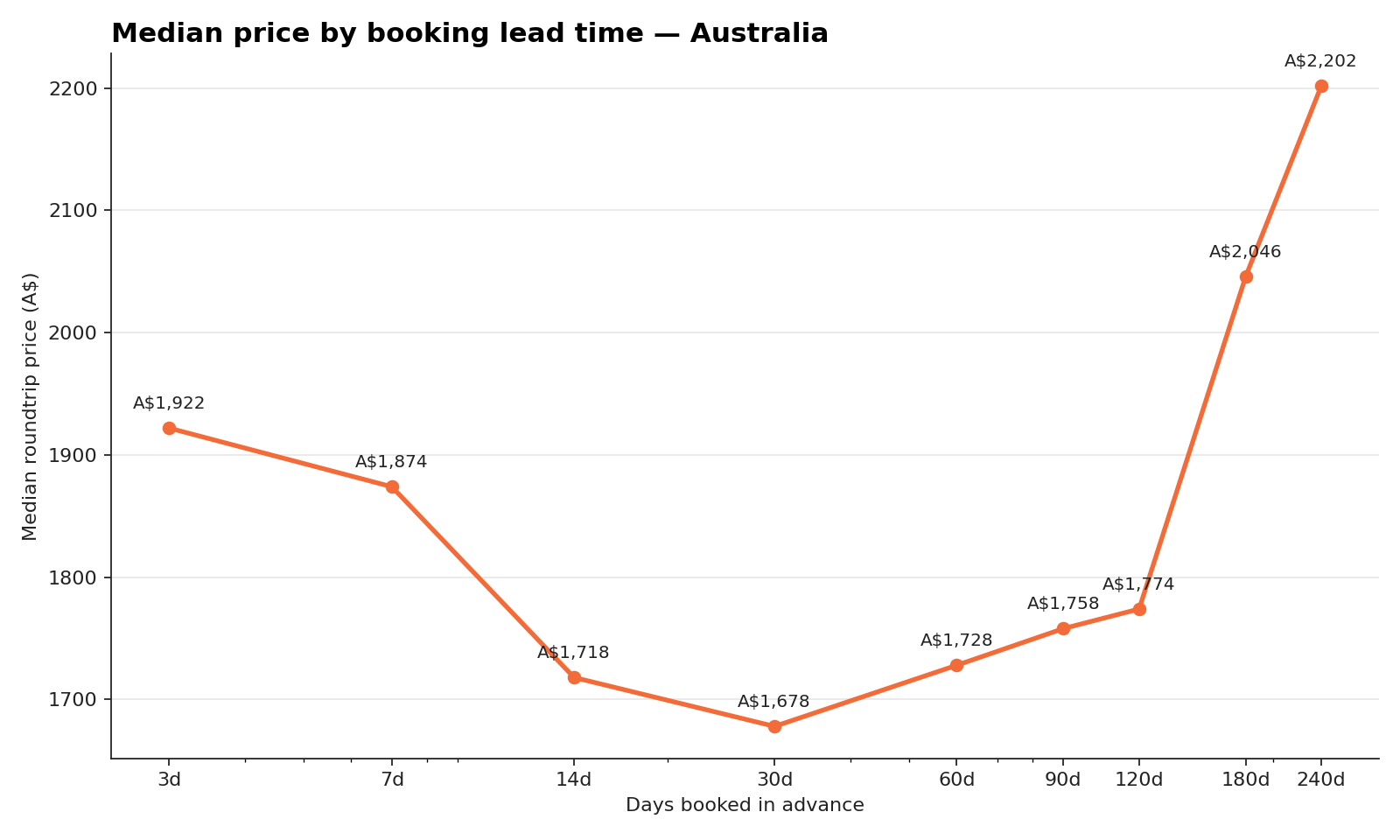
Median roundtrip fare by booking-window length (days before departure) for flights from Australia. Based on 2,691,313 search snapshots.
Frequently asked questions
What is the cheapest month to fly internationally from Australia?
March is the cheapest month to fly, with prices dropping to a seasonal low index of 81.3. This represents a 68.7 point difference in the price index compared to the December peak, when holiday demand pushes the index up to 150.0.
Why are flights to Europe and North America so expensive?
Long-haul routes carry an unavoidable distance-based premium due to Australia's high isolation index of 0.90. This market reality means a median return ticket to London sits at A$1,868 and Los Angeles at A$1,581, reflecting the high cost of operating ultra-long-haul services.
Is Bali really the cheapest international destination for Australians?
Yes, Denpasar is mathematically the ultimate budget option for the country, holding a dominant 6.05% share of all outbound flight searches. With a median roundtrip price of A$550, it is the cheapest major international gateway available, costing less than a third of a flight to London.
How much can I save by flying to secondary airports in Asia?
Choosing secondary entry points can yield significant savings, such as routing to Osaka instead of Tokyo. While Tokyo (Haneda) has a median price of A$1,092, Osaka (Kansai) sits at A$891, saving you A$201 just by switching your arrival city.
Do Australian passport holders need to arrange visas before flying?
Australians enjoy excellent global mobility, with a Henley Passport Index rank of 7 allowing visa-free or visa-on-arrival access to 182 destinations. However, you must still check the specific entry registration rules for your destination country before departure.
While Indonesia acts as a vital budget alternative, escaping Australia’s distance-based premium on long-haul routes requires precise timing. Ratepunk’s price-tracking browser extension monitors these volatile corridors, alerting you the moment the price floor drops on your chosen dates. Install the RatePunk extension to let the data work for you.
Methodology and data sources
We base our analysis on Ratepunk's flight-price dataset, which contains 40,688,214 anonymised economy-class searches across 22,792 routes. This dataset captures search records from 5 August 2025 to 7 May 2026 for departures scheduled between 5 August 2025 and 30 April 2027. All prices are calculated and shown in Australian Dollars (AUD).
To ensure clarity, our destination and city tables report both the average and the typical (median) price. All booking-timing and weekday figures are medians, which are less distorted by extreme price spikes than averages. Seasonality charts use an index where 100 represents the annual average fare.
May 29, 2026